
Ch. 7 - Estimating Parameters and Determining Sample Sizes
Triola - Elementary Statistics 14th Edition
Triola14th EditionElementary StatisticsISBN: 9780137366446Not the one you use?Change textbook
Chapter 7, Problem 7.r.2

Bachelor’s Degree The president of Brown University wants to estimate the mean time (years) it takes students to earn a bachelor’s degree. How many students must be surveyed in order to be 95% confident that the estimate is within 0.2 year of the true population mean? Assume that the population standard deviation is sigma=1.3 years

Verified step by step guidance
1
Step 1: Identify the key components of the problem. The confidence level is 95%, the margin of error (E) is 0.2 years, the population standard deviation (σ) is 1.3 years, and we need to determine the required sample size (n).
Step 2: Recall the formula for determining the sample size for estimating a population mean: n = (Z * σ / E)^2. Here, Z is the critical value corresponding to the desired confidence level, σ is the population standard deviation, and E is the margin of error.
Step 3: Determine the critical value (Z) for a 95% confidence level. For a 95% confidence level, the Z-value is approximately 1.96. This value is obtained from the standard normal distribution table.
Step 4: Substitute the known values into the formula. Replace Z with 1.96, σ with 1.3, and E with 0.2 in the formula: n = (1.96 * 1.3 / 0.2)^2.
Step 5: Simplify the expression inside the parentheses and then square the result to calculate the required sample size. Ensure the final value of n is rounded up to the nearest whole number, as sample size must be an integer.

Verified video answer for a similar problem:

This video solution was recommended by our tutors as helpful for the problem above.
Video duration:
1m
Was this helpful?

Key Concepts

Here are the essential concepts you must grasp in order to answer the question correctly.

Sample Size Determination

Sample size determination is a statistical process used to calculate the number of observations needed to achieve a desired level of confidence and precision in estimating a population parameter. In this case, it involves using the formula that incorporates the desired margin of error, the population standard deviation, and the critical value from the normal distribution corresponding to the confidence level.
Recommended video:
Guided course
06:14
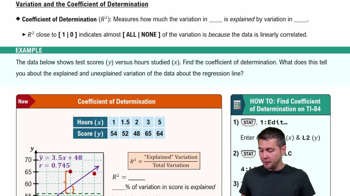
Coefficient of Determination

Confidence Interval

A confidence interval is a range of values, derived from sample statistics, that is likely to contain the true population parameter with a specified level of confidence. For example, a 95% confidence interval suggests that if we were to take many samples and build intervals, approximately 95% of those intervals would contain the true mean. This concept is crucial for understanding how precise our estimate is.
Recommended video:
06:33
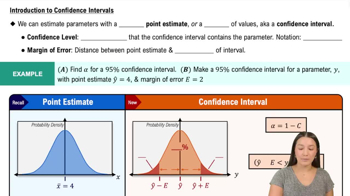
Introduction to Confidence Intervals

Population Standard Deviation

Population standard deviation is a measure of the amount of variation or dispersion in a set of values. It quantifies how much individual data points differ from the population mean. In this scenario, knowing the population standard deviation (sigma = 1.3 years) is essential for calculating the sample size needed to ensure that the estimate of the mean time to earn a bachelor’s degree is accurate within the specified margin of error.
Recommended video:
04:48
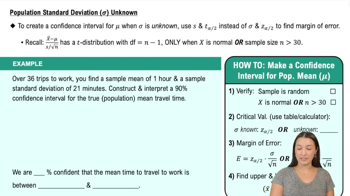
Population Standard Deviation Unknown