
Ch. 7 - Estimating Parameters and Determining Sample Sizes
Triola - Elementary Statistics 14th Edition
Triola14th EditionElementary StatisticsISBN: 9780137366446Not the one you use?Change textbook
Chapter 7, Problem 7.3d

Voting Survey In a survey of 1002 people, 70% said that they voted in a recent presidential election (based on data from ICR Research Group). Voting records show that 61% of eligible voters actually did vote.


d. Are the survey results consistent with the actual voter turnout of 61%? Why or why not?

Verified step by step guidance
1
Step 1: Define the null hypothesis (H₀) and the alternative hypothesis (H₁). The null hypothesis assumes that the survey results are consistent with the actual voter turnout, i.e., the proportion of people who said they voted (p̂ = 0.70) is equal to the actual voter turnout (p = 0.61). The alternative hypothesis assumes that the survey results are not consistent with the actual voter turnout.
Step 2: Identify the sample size (n), the sample proportion (p̂), and the population proportion (p). Here, n = 1002, p̂ = 0.70, and p = 0.61.
Step 3: Calculate the standard error (SE) of the sample proportion using the formula: SE = sqrt((p * (1 - p)) / n). This measures the variability of the sample proportion under the assumption that the null hypothesis is true.
Step 4: Compute the z-score to determine how many standard errors the sample proportion (p̂) is away from the population proportion (p). Use the formula: z = (p̂ - p) / SE.
Step 5: Compare the calculated z-score to the critical z-value for a chosen significance level (e.g., α = 0.05). If the z-score falls outside the critical range, reject the null hypothesis and conclude that the survey results are not consistent with the actual voter turnout. Otherwise, fail to reject the null hypothesis and conclude that the survey results are consistent with the actual voter turnout.

Verified video answer for a similar problem:

This video solution was recommended by our tutors as helpful for the problem above.
Video duration:
4m
Was this helpful?

Key Concepts

Here are the essential concepts you must grasp in order to answer the question correctly.

Survey Sampling

Survey sampling involves selecting a subset of individuals from a larger population to estimate characteristics of the whole group. In this case, the survey of 1002 people aims to infer voting behavior among the entire eligible voter population. Understanding sampling methods and biases is crucial for evaluating the reliability of survey results.
Recommended video:
05:11
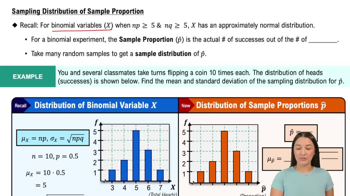
Sampling Distribution of Sample Proportion

Response Bias

Response bias occurs when participants in a survey provide inaccurate or untruthful answers, often due to social desirability or misunderstanding the question. In the context of the voting survey, the discrepancy between the 70% reported voting and the 61% actual turnout may suggest that respondents over-reported their voting behavior, highlighting the importance of considering bias in survey results.
Recommended video:
06:10
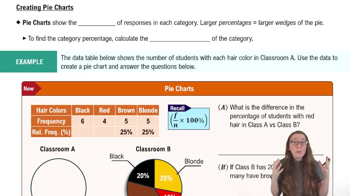
Creating Pie Charts

Statistical Consistency

Statistical consistency refers to the degree to which survey results align with actual data or established benchmarks. In this scenario, comparing the 70% survey result with the 61% actual voter turnout raises questions about the validity of the survey. Analyzing the consistency helps determine if the survey accurately reflects the true voting behavior of the population.
Recommended video:
Guided course
05:53
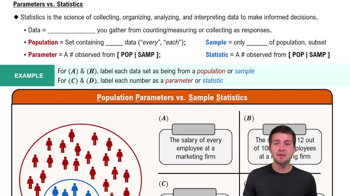
Parameters vs. Statistics
Related Practice
Textbook Question

E-Cigarettes A New York Times article reported that a survey conducted in 2014 included 36,000 adults, with 3.7% of them being regular users of e-cigarettes. Because e-cigarette use is relatively new, there is a need to obtain today’s usage rate. How many adults must be surveyed now if we want a confidence level of 95% and a margin of error of 1.5 percentage points?


c. Does the use of the result from the 2014 survey have much of an effect on the sample size?

Textbook Question

Smart Phone Apple is planning for the launch of a new and improved iPhone. The marketing team wants to know the worldwide percentage of consumers who intend to purchase the new model, so a survey is being planned. How many people must be surveyed in order to be 90% confident that the estimated percentage is within three percentage points of the true population percentage?


c. Given that the required sample size is relatively small, could you simply survey the people that you know?

Textbook Question

Tour de France Listed below are the average speeds (km/h) of winners of the Tour de France men’s bicycle race. The speeds are listed in order by year, beginning with the year 2000.


a. Construct a 95% confidence interval estimate of the population mean.


Textbook Question

Bachelor’s Degree in Four Years In a study of government financial aid for college students, it becomes necessary to estimate the percentage of full-time college students who earn a bachelor’s degree in four years or less. Find the sample size needed to estimate that percentage. Use a 0.1 margin of error, and use a confidence level of 95%.


b. Assume that prior studies have shown that about 40% of full-time students earn bachelor’s degrees in four years or less.


Textbook Question

Bachelor’s Degree in Four Years In a study of government financial aid for college students, it becomes necessary to estimate the percentage of full-time college students who earn a bachelor’s degree in four years or less. Find the sample size needed to estimate that percentage. Use a 0.1 margin of error, and use a confidence level of 95%.


a. Assume that nothing is known about the percentage to be estimated.


Textbook Question

Alcohol in Children’s Movies Listed below is a simple random sample of times (seconds) that animated children’s movies showed the use of alcohol (based on Data Set 20 “Alcohol and Tobacco in Movies” in Appendix B).


a. Are the requirements for constructing a 95% confidence interval estimate of the population mean satisfied? If so, construct that confidence interval.