
Ch. 6 - Normal Probability Distributions
Triola - Elementary Statistics 14th Edition
Triola14th EditionElementary StatisticsISBN: 9780137366446Not the one you use?Change textbook
Chapter 6, Problem 6.3.9a

In Exercises 7–10, use the same population of {4, 5, 9} that was used in Examples 2 and 5. As in Examples 2 and 5, assume that samples of size n = 2 are randomly selected with replacement.


Sampling Distribution of the Sample Median


a. Find the value of the population median.

Verified step by step guidance
1
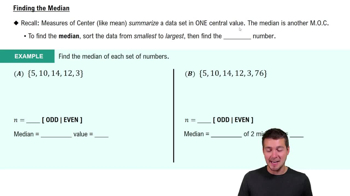
Step 1: Understand the concept of the median. The median is the middle value of a data set when the values are arranged in ascending order. If the number of values is odd, the median is the middle value. If the number of values is even, the median is the average of the two middle values.
Step 2: Arrange the population values {4, 5, 9} in ascending order. Since the population is already sorted, no further action is needed.
Step 3: Determine the number of values in the population. Here, the population consists of three values: 4, 5, and 9.
Step 4: Identify the middle value of the population. Since the population size is odd (n = 3), the median is the middle value of the sorted list, which is the second value.
Step 5: Conclude that the population median is the middle value of the sorted population, which can be directly identified from the ordered list.

Verified video answer for a similar problem:

This video solution was recommended by our tutors as helpful for the problem above.
Video duration:
1m
Was this helpful?

Key Concepts

Here are the essential concepts you must grasp in order to answer the question correctly.

Population Median

The population median is the middle value of a dataset when it is ordered from least to greatest. For an odd number of observations, it is the central number, while for an even number, it is the average of the two central numbers. In the context of the given population {4, 5, 9}, the median is calculated by ordering the values and identifying the middle point.
Recommended video:
Guided course
03:26
Calculating the Median

Sampling Distribution

A sampling distribution is the probability distribution of a statistic (like the median) obtained from a large number of samples drawn from a specific population. It illustrates how the statistic varies from sample to sample. Understanding the sampling distribution is crucial for making inferences about the population based on sample data, especially when samples are taken with replacement.
Recommended video:
05:11
Sampling Distribution of Sample Proportion

Random Sampling with Replacement

Random sampling with replacement means that each time an item is selected from the population, it is returned before the next selection. This method ensures that each selection is independent and that the same item can be chosen multiple times. It is important for maintaining the integrity of the sampling process and for accurately estimating the sampling distribution of statistics like the median.
Recommended video:
05:11
Sampling Distribution of Sample Proportion
Related Practice
Textbook Question

In Exercises 7–10, use the same population of {4, 5, 9} that was used in Examples 2 and 5. As in Examples 2 and 5, assume that samples of size n = 2 are randomly selected with replacement.


Sampling Distribution of the Sample Standard Deviation For the following, round results to three decimal places.


a. Find the value of the population standard deviation σ.

Textbook Question

Ergonomics. Exercises 9–16 involve applications to ergonomics, as described in the Chapter Problem.


Aircraft Cockpit The overhead panel in an aircraft cockpit typically includes controls for such features as landing lights, fuel booster pumps, and oxygen. It is important for pilots to be able to reach those overhead controls while sitting. Seated adult males have overhead grip reaches that are normally distributed with a mean of 51.6 in. and a standard deviation of 2.2 in.


a. If an aircraft is designed for pilots with an overhead grip reach of 53 in., what percentage of adult males would not be able to reach the overhead controls? Is that percentage too high?

Textbook Question

Using the Central Limit Theorem. In Exercises 5–8, assume that the amounts of weight that male college students gain during their freshman year are normally distributed with a mean of 1.2 kg and a standard deviation of 4.9 kg (based on Data Set 13 “Freshman 15” in Appendix B).


a. If 1 male college student is randomly selected, find the probability that he gains at least 2.0 kg during his freshman year..)

Textbook Question

Hybridization A hybridization experiment begins with four peas having yellow pods and one pea having a green pod. Two of the peas are randomly selected with replacement from this population.


a. After identifying the 25 different possible samples, find the proportion of peas with yellow pods in each of them, then construct a table to des

Textbook Question

Ergonomics. Exercises 9–16 involve applications to ergonomics, as described in the Chapter Problem.


Redesign of Ejection Seats When women were finally allowed to become pilots of fighter jets, engineers needed to redesign the ejection seats because they had been originally designed for men only. The ACES-II ejection seats were designed for men weighing between 140 lb and 211 lb. Weights of women are now normally distributed with a mean of 171 lb and a standard deviation of 46 lb (based on Data Set 1 “Body Data” in Appendix B).


a. If 1 woman is randomly selected, find the probability that her weight is between 140 lb and 211 lb.

Textbook Question

Continuity Correction In testing the assumption that the probability of a baby boy is 0.512, a geneticist obtains a random sample of 1000 births and finds that 502 of them are boys. Using the continuity correction, describe the area under the graph of a normal distribution corresponding to the following. (For example, the area corresponding to “the probability of at least 502 boys” is this: the area to the right of 501.5.)


a. The probability of 502 or fewer boys