Ch. 6 - Normal Probability Distributions
Triola - Elementary Statistics 14th Edition
Triola14th EditionElementary StatisticsISBN: 9780137366446Not the one you use?Change textbook
Chapter 6, Problem 6.3.8a

In Exercises 7–10, use the same population of {4, 5, 9} that was used in Examples 2 and 5. As in Examples 2 and 5, assume that samples of size n = 2 are randomly selected with replacement.


Sampling Distribution of the Sample Standard Deviation For the following, round results to three decimal places.


a. Find the value of the population standard deviation σ.

Verified step by step guidance
1
Step 1: Recall the formula for the population standard deviation (σ). The formula is: σ = sqrt((Σ(xᵢ - μ)²) / N), where xᵢ represents each data point, μ is the population mean, and N is the population size.
Step 2: Calculate the population mean (μ). Use the formula μ = Σxᵢ / N, where Σxᵢ is the sum of all data points in the population and N is the number of data points in the population.
Step 3: Subtract the population mean (μ) from each data point in the population to find the deviations (xᵢ - μ). Then, square each deviation to get (xᵢ - μ)².
Step 4: Sum all the squared deviations (Σ(xᵢ - μ)²). This gives the total squared deviation for the population.
Step 5: Divide the total squared deviation by the population size (N) and take the square root of the result to find the population standard deviation (σ). Round the final result to three decimal places as instructed.

Verified video answer for a similar problem:

This video solution was recommended by our tutors as helpful for the problem above.
Video duration:
2m
Was this helpful?

Key Concepts

Here are the essential concepts you must grasp in order to answer the question correctly.

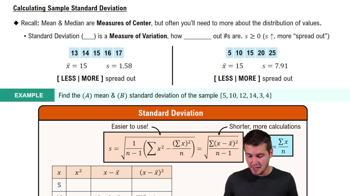
Population Standard Deviation

The population standard deviation (σ) is a measure of the dispersion or spread of a set of values in a population. It quantifies how much the individual data points deviate from the population mean. To calculate it, you take the square root of the variance, which is the average of the squared differences from the mean. Understanding this concept is crucial for analyzing the variability within a population.
Recommended video:
Guided course
08:45
Calculating Standard Deviation

Sampling Distribution

The sampling distribution refers to the probability distribution of a statistic (like the sample mean or sample standard deviation) obtained from a large number of samples drawn from the same population. It helps in understanding how sample statistics vary from sample to sample. In this context, knowing the sampling distribution of the sample standard deviation is essential for making inferences about the population based on sample data.
Recommended video:
05:11
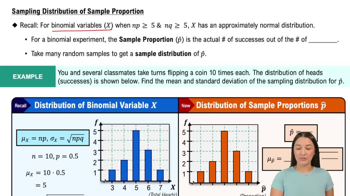
Sampling Distribution of Sample Proportion

Random Sampling with Replacement

Random sampling with replacement means that each time a sample is drawn from the population, the selected element is returned to the population before the next draw. This method ensures that each selection is independent and that the probability of selecting any particular element remains constant across samples. This concept is important for accurately assessing the variability and distribution of sample statistics.
Recommended video:
05:11
Sampling Distribution of Sample Proportion
Related Practice
Textbook Question

Using the Central Limit Theorem. In Exercises 5–8, assume that the amounts of weight that male college students gain during their freshman year are normally distributed with a mean of 1.2 kg and a standard deviation of 4.9 kg (based on Data Set 13 “Freshman 15” in Appendix B).


a. If 1 male college student is randomly selected, find the probability that he gains at least 2.0 kg during his freshman year..)

Textbook Question

Hybridization A hybridization experiment begins with four peas having yellow pods and one pea having a green pod. Two of the peas are randomly selected with replacement from this population.


a. After identifying the 25 different possible samples, find the proportion of peas with yellow pods in each of them, then construct a table to des

Textbook Question

In Exercises 7–10, use the same population of {4, 5, 9} that was used in Examples 2 and 5. As in Examples 2 and 5, assume that samples of size n = 2 are randomly selected with replacement.


Sampling Distribution of the Sample Median


a. Find the value of the population median.

Textbook Question

In Exercises 7–10, use the same population of {4, 5, 9} that was used in Examples 2 and 5. As in Examples 2 and 5, assume that samples of size n = 2 are randomly selected with replacement.


Sampling Distribution of the Sample Proportion


a. For the population, find the proportion of odd numbers.

Textbook Question

Smartphones Based on an LG smartphone survey, assume that 51% of adults with smartphones use them in theaters. In a separate survey of 250 adults with smartphones, it is found that 109 use them in theaters.


a. If the 51% rate is correct, find the probability of getting 109 or fewer smartphone owners who use them in theaters.

1
views
Textbook Question

Cell Phones and Brain Cancer In a study of 420,095 cell phone users in Denmark, it was found that 135 developed cancer of the brain or nervous system. For those not using cell phones, there is a 0.000340 probability of a person developing cancer of the brain or nervous system. We therefore expect about 143 cases of such cancers in a group of 420,095 randomly selected people.

a. Find the probability of 135 or fewer cases of such cancers in a group of 420,095 people.

b. What do these results suggest about media reports that suggest cell phones cause cancer of the brain or nervous system?