
Ch. 6 - Normal Probability Distributions
Triola - Elementary Statistics 14th Edition
Triola14th EditionElementary StatisticsISBN: 9780137366446Not the one you use?Change textbook
Chapter 6, Problem 6.4.16a

Ergonomics. Exercises 9–16 involve applications to ergonomics, as described in the Chapter Problem.


Aircraft Cockpit The overhead panel in an aircraft cockpit typically includes controls for such features as landing lights, fuel booster pumps, and oxygen. It is important for pilots to be able to reach those overhead controls while sitting. Seated adult males have overhead grip reaches that are normally distributed with a mean of 51.6 in. and a standard deviation of 2.2 in.


a. If an aircraft is designed for pilots with an overhead grip reach of 53 in., what percentage of adult males would not be able to reach the overhead controls? Is that percentage too high?

Verified step by step guidance
1
Step 1: Identify the key parameters of the normal distribution. The problem states that the overhead grip reaches are normally distributed with a mean (μ) of 51.6 inches and a standard deviation (σ) of 2.2 inches. The threshold value for the overhead grip reach is 53 inches.
Step 2: Standardize the threshold value using the z-score formula. The z-score formula is given by: z=x-μσ, where x is the threshold value (53 inches), μ is the mean (51.6 inches), and σ is the standard deviation (2.2 inches). Substitute the values into the formula to calculate the z-score.
Step 3: Use the z-score to find the cumulative probability. Once the z-score is calculated, use a standard normal distribution table or a statistical software to find the cumulative probability corresponding to the z-score. This cumulative probability represents the proportion of adult males who can reach the overhead controls.
Step 4: Subtract the cumulative probability from 1 to find the percentage of adult males who cannot reach the overhead controls. The formula is: P=1-C, where P is the percentage of males who cannot reach, and C is the cumulative probability from Step 3.
Step 5: Evaluate whether the percentage of males who cannot reach the controls is too high. Compare the result from Step 4 to a reasonable threshold (e.g., 5% or 10%) to determine if the design is acceptable or if adjustments are needed to accommodate more pilots.

Verified video answer for a similar problem:

This video solution was recommended by our tutors as helpful for the problem above.
Video duration:
3m
Was this helpful?

Key Concepts

Here are the essential concepts you must grasp in order to answer the question correctly.

Normal Distribution

Normal distribution is a probability distribution that is symmetric about the mean, indicating that data near the mean are more frequent in occurrence than data far from the mean. In this context, the overhead grip reaches of seated adult males follow a normal distribution, characterized by a mean (average) and a standard deviation (spread). Understanding this concept is crucial for determining the percentage of the population that falls above or below a certain reach.
Recommended video:
Guided course
09:47
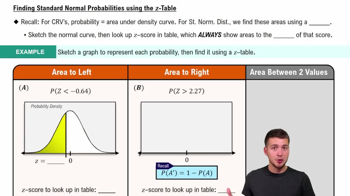
Finding Standard Normal Probabilities using z-Table

Z-Score

A Z-score is a statistical measurement that describes a value's relationship to the mean of a group of values. It is calculated by subtracting the mean from the value and then dividing by the standard deviation. In this scenario, calculating the Z-score for a grip reach of 53 inches will help determine how many standard deviations this value is from the mean, allowing us to find the corresponding percentile in the normal distribution.
Recommended video:
Guided course
06:31
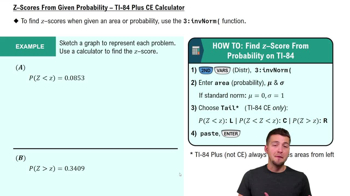
Z-Scores From Given Probability - TI-84 (CE) Calculator

Percentile

A percentile is a measure used in statistics indicating the value below which a given percentage of observations fall. For example, if a certain grip reach is at the 75th percentile, it means that 75% of the population has a grip reach less than that value. In this question, calculating the percentile for the grip reach of 53 inches will help assess how many adult males would be unable to reach the overhead controls, informing whether the design is suitable for the intended user population.
Related Practice
Textbook Question

Ergonomics. Exercises 9–16 involve applications to ergonomics, as described in the Chapter Problem.


Safe Loading of Elevators The elevator in the car rental building at San Francisco International Airport has a placard stating that the maximum capacity is “4000 lb—27 passengers.” Because 4000/27=148, this converts to a mean passenger weight of 148 lb when the elevator is full. We will assume a worst-case scenario in which the elevator is filled with 27 adult males. Based on Data Set 1 “Body Data” in Appendix B, assume that adult males have weights that are normally distributed with a mean of 189 lb and a standard deviation of 39 lb.


a. Find the probability that 1 randomly selected adult male has a weight greater than 148 lb.

Textbook Question

Using the Central Limit Theorem. In Exercises 5–8, assume that the amounts of weight that male college students gain during their freshman year are normally distributed with a mean of 1.2 kg and a standard deviation of 4.9 kg (based on Data Set 13 “Freshman 15” in Appendix B).

a. If 1 male college student is randomly selected, find the probability that he gains between 0 kg and 3 kg during freshman year.

Textbook Question

Ergonomics. Exercises 9–16 involve applications to ergonomics, as described in the Chapter Problem.


Redesign of Ejection Seats When women were finally allowed to become pilots of fighter jets, engineers needed to redesign the ejection seats because they had been originally designed for men only. The ACES-II ejection seats were designed for men weighing between 140 lb and 211 lb. Weights of women are now normally distributed with a mean of 171 lb and a standard deviation of 46 lb (based on Data Set 1 “Body Data” in Appendix B).


a. If 1 woman is randomly selected, find the probability that her weight is between 140 lb and 211 lb.

Textbook Question

In Exercises 7–10, use the same population of {4, 5, 9} that was used in Examples 2 and 5. As in Examples 2 and 5, assume that samples of size n = 2 are randomly selected with replacement.


Sampling Distribution of the Sample Median


a. Find the value of the population median.

Textbook Question

Transformations The heights (in inches) of women listed in Data Set 1 “Body Data” in Appendix B have a distribution that is approximately normal, so it appears that those heights are from a normally distributed population.


a. If 2 inches is added to each height, are the new heights also normally distributed?

Textbook Question

Continuity Correction In testing the assumption that the probability of a baby boy is 0.512, a geneticist obtains a random sample of 1000 births and finds that 502 of them are boys. Using the continuity correction, describe the area under the graph of a normal distribution corresponding to the following. (For example, the area corresponding to “the probability of at least 502 boys” is this: the area to the right of 501.5.)


a. The probability of 502 or fewer boys