Ch. 5 - Discrete Probability Distributions
Triola - Elementary Statistics 14th Edition
Triola14th EditionElementary StatisticsISBN: 9780137366446Not the one you use?Change textbook
Chapter 5, Problem 5.1.4

Significant For 100 births, P(exactly 56 girls) and P(56 or more girls) Is 56 girls in 100 births a significantly high number of girls? Which probability is relevant to answering that question?

Verified step by step guidance
1
Step 1: Identify the type of probability distribution relevant to the problem. Since the problem involves counting the number of girls in 100 births, this is a binomial distribution. The binomial distribution is defined by two parameters: the number of trials (n = 100) and the probability of success (p = 0.5, assuming equal likelihood of a boy or girl).
Step 2: Calculate P(exactly 56 girls). Use the binomial probability formula: \( P(X = k) = \binom{n}{k} p^k (1-p)^{n-k} \), where \( \binom{n}{k} \) is the binomial coefficient. Plug in \( n = 100 \), \( k = 56 \), and \( p = 0.5 \) to compute this probability.
Step 3: Calculate P(56 or more girls). This is the cumulative probability \( P(X \geq 56) \), which can be expressed as \( P(X = 56) + P(X = 57) + \dots + P(X = 100) \). Use the binomial formula repeatedly or leverage statistical software or tables to compute this cumulative probability.
Step 4: Determine which probability is relevant to answering the question of whether 56 girls in 100 births is significantly high. To assess significance, we typically compare \( P(X \geq 56) \) to a threshold (e.g., 0.05 for a 5% significance level). If \( P(X \geq 56) \) is less than the threshold, then 56 girls is considered significantly high.
Step 5: Interpret the results. If \( P(X \geq 56) \) is very small, it suggests that 56 or more girls in 100 births is an unusual event under the assumption of equal likelihood for boys and girls. This conclusion is based on the cumulative probability rather than the probability of exactly 56 girls.

Verified video answer for a similar problem:

This video solution was recommended by our tutors as helpful for the problem above.
Video duration:
3m
Was this helpful?

Key Concepts

Here are the essential concepts you must grasp in order to answer the question correctly.

Binomial Distribution

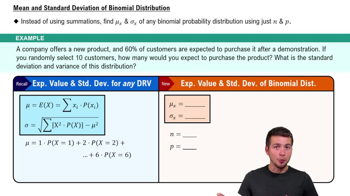
The binomial distribution models the number of successes in a fixed number of independent Bernoulli trials, each with the same probability of success. In this context, it can be used to determine the probability of having exactly 56 girls in 100 births, where each birth can be considered a trial with a success probability of 0.5 (assuming equal likelihood of boys and girls).
Recommended video:
Guided course
03:28
Mean & Standard Deviation of Binomial Distribution

Probability Mass Function (PMF)

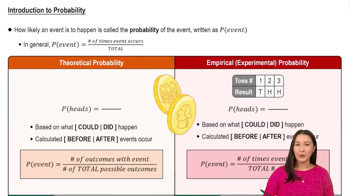
The probability mass function gives the probability of a discrete random variable taking on a specific value. For the binomial distribution, the PMF can be used to calculate P(exactly 56 girls) by applying the formula: P(X = k) = (n choose k) * p^k * (1-p)^(n-k), where n is the number of trials, k is the number of successes, and p is the probability of success.
Recommended video:
5:37
Introduction to Probability

Cumulative Distribution Function (CDF)

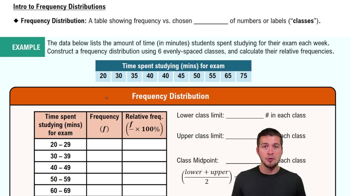
The cumulative distribution function provides the probability that a random variable takes on a value less than or equal to a specific value. To determine P(56 or more girls), the CDF can be used to sum the probabilities from 56 to 100, or alternatively, 1 minus the CDF value at 55, which gives the probability of having 56 or more girls in 100 births.
Recommended video:
Guided course
06:38
Intro to Frequency Distributions
Related Practice
Textbook Question

Notation Assume that we want to find the probability that when five speaking characters in movies are randomly selected, exactly two of them are females. Also assume that when randomly selecting a speaking character in a movie, the probability of getting a female is 0.331. Identify the values of n, x, p, and q.

1
views
Textbook Question

Identifying Probability Distributions. In Exercises 7–14, determine whether a probability distribution is given. If a probability distribution is given, find its mean and standard deviation. If a probability distribution is not given, identify the requirements that are not satisfied.

Fear of Heights The table lists results from a survey of 285 subjects who were asked, “Are you afraid of heights in tall buildings?” The results are from USA Today.

1
views
Textbook Question

Identifying Probability Distributions. In Exercises 7–14, determine whether a probability distribution is given. If a probability distribution is given, find its mean and standard deviation. If a probability distribution is not given, identify the requirements that are not satisfied.

Plane Crashes The table lists causes of fatal plane crashes with their corresponding probabilities.

1
views
Textbook Question

Biometric Security In a USA Today survey of 510 people, 270 (or 53%) said that we should replace passwords with biometric security, such as fingerprints. Use the following probabilities related to determining whether the result of 270 is significantly high (assuming the true rate is 50%). Is 270 significantly high? What should be concluded about the claim that the majority of the population says that we should replace passwords with biometric security? Explain.


" style="" width="430">

1
views
Textbook Question

Tennis Challenge In a recent U.S. Open tennis tournament, there were 945 challenges made by singles players, and 255 of them resulted in referee calls that were overturned. The accompanying table lists the results by gender.


a. If 1 of the 945 challenges is randomly selected, what is the probability that it resulted in an overturned call?

1
views
Textbook Question

Planets The planets of the solar system have the numbers of moons listed below in order from the sun. (Pluto is not included because it was uninvited from the solar system party in 2006.) Include appropriate units whenever relevant.


0 0 1 2 17 28 21 8


i. What is the level of measurement of the data: nominal, ordinal, interval, or ratio?

j. Are the data discrete or continuous?

3
views