Ch. 5 - Discrete Probability Distributions
Triola - Elementary Statistics 14th Edition
Triola14th EditionElementary StatisticsISBN: 9780137366446Not the one you use?Change textbook
Chapter 5, Problem 5.1.27

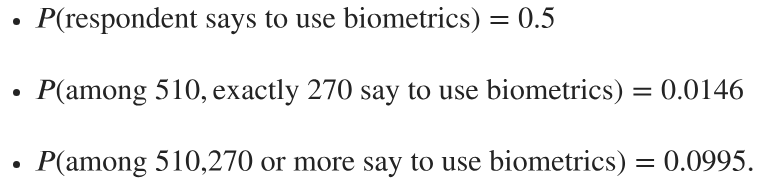
Biometric Security In a USA Today survey of 510 people, 270 (or 53%) said that we should replace passwords with biometric security, such as fingerprints. Use the following probabilities related to determining whether the result of 270 is significantly high (assuming the true rate is 50%). Is 270 significantly high? What should be concluded about the claim that the majority of the population says that we should replace passwords with biometric security? Explain.


<IMAGE>

Verified step by step guidance
1
Step 1: Identify the null hypothesis (H0) and alternative hypothesis (H1). The null hypothesis is that the true proportion of people who support biometric security is 50% (P = 0.5). The alternative hypothesis is that the proportion is greater than 50% (P > 0.5).
Step 2: Calculate the expected number of people who would say 'yes' under the null hypothesis. This is given by the formula: E = n * P, where n is the sample size (510) and P is the probability (0.5).
Step 3: Determine whether the observed value (270) is significantly high by comparing the probability of observing 270 or more people saying 'yes' (P(270 or more)) to a significance level, typically α = 0.05. If P(270 or more) < α, the result is considered significantly high.
Step 4: Use the provided probabilities to interpret the results. The probability of observing exactly 270 people saying 'yes' is 0.0146, and the probability of observing 270 or more is 0.0995. Compare these values to the significance level to draw conclusions.
Step 5: Based on the comparison, conclude whether the claim that the majority of the population supports replacing passwords with biometric security is supported. If the result is not significantly high, the claim cannot be supported statistically.

Verified video answer for a similar problem:

This video solution was recommended by our tutors as helpful for the problem above.
Video duration:
4m
Was this helpful?

Key Concepts

Here are the essential concepts you must grasp in order to answer the question correctly.

Hypothesis Testing

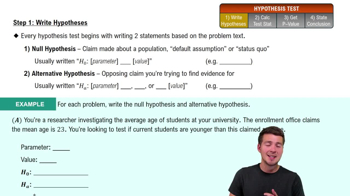
Hypothesis testing is a statistical method used to make decisions about a population based on sample data. In this context, the null hypothesis (H0) posits that the true proportion of people favoring biometric security is 50%. The alternative hypothesis (H1) suggests that this proportion is greater than 50%. The goal is to determine if the observed data (270 out of 510) provides sufficient evidence to reject the null hypothesis.
Recommended video:
Guided course
06:21
Step 1: Write Hypotheses

P-Value

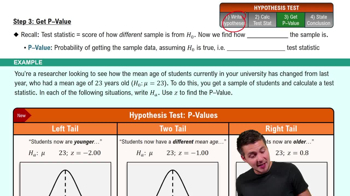
The p-value is a measure that helps determine the significance of the results in hypothesis testing. It represents the probability of observing the sample data, or something more extreme, assuming the null hypothesis is true. In this case, the p-value of 0.0995 indicates the likelihood of obtaining 270 or more respondents favoring biometric security if the true proportion is indeed 50%. A smaller p-value would suggest stronger evidence against the null hypothesis.
Recommended video:
Guided course
06:50
Step 3: Get P-Value

Significance Level

The significance level, often denoted as alpha (α), is a threshold set by the researcher to determine whether to reject the null hypothesis. Commonly, a significance level of 0.05 is used, meaning there is a 5% risk of concluding that a difference exists when there is none. In this scenario, if the p-value (0.0995) exceeds the significance level, we fail to reject the null hypothesis, suggesting that the claim about the majority favoring biometric security may not be statistically significant.
Recommended video:
Guided course
04:46
Step 4: State Conclusion Example 4
Related Practice
Textbook Question

Notation Assume that we want to find the probability that when five speaking characters in movies are randomly selected, exactly two of them are females. Also assume that when randomly selecting a speaking character in a movie, the probability of getting a female is 0.331. Identify the values of n, x, p, and q.

1
views
Textbook Question

Significant For 100 births, P(exactly 56 girls) and P(56 or more girls) Is 56 girls in 100 births a significantly high number of girls? Which probability is relevant to answering that question?

1
views
Textbook Question

Independent Events Again assume that when randomly selecting a speaking character in a movie, the probability of getting a female is 0.331, as in Exercise 1. If we want to find the probability of 20 females when 50 different speaking characters are randomly selected from a population of 1500 speaking characters, are the 50 selections independent? Using the 5% guideline for cumbersome calculations, can they be treated as being independent?

1
views
Textbook Question

Identifying Probability Distributions. In Exercises 7–14, determine whether a probability distribution is given. If a probability distribution is given, find its mean and standard deviation. If a probability distribution is not given, identify the requirements that are not satisfied.

Plane Crashes The table lists causes of fatal plane crashes with their corresponding probabilities.

1
views
Textbook Question

Discrete or Continuous? Is the random variable given in the table from Exercise 1 discrete or continuous? Explain.

1
views
Textbook Question

Lottery. In Exercises 15–20, refer to the accompanying table, which describes probabilities for the California Daily 4 lottery. The player selects four digits with repetition allowed, and the random variable x is the number of digits that match those in the same order that they are drawn (for a “straight” bet).


Range Rule of Thumb for Significant Events Use the range rule of thumb to determine whether 4 matches is a significantly high number of matches.