Ch. 5 - Discrete Probability Distributions
Triola - Elementary Statistics 14th Edition
Triola14th EditionElementary StatisticsISBN: 9780137366446Not the one you use?Change textbook
Chapter 5, Problem 5.C.1.5

Planets The planets of the solar system have the numbers of moons listed below in order from the sun. (Pluto is not included because it was uninvited from the solar system party in 2006.) Include appropriate units whenever relevant.


0 0 1 2 17 28 21 8


i. What is the level of measurement of the data: nominal, ordinal, interval, or ratio?
j. Are the data discrete or continuous?

Verified step by step guidance
1
Step 1: Understand the levels of measurement. Nominal data is categorized without a specific order, ordinal data has a defined order but no consistent difference between values, interval data has ordered categories with consistent differences but no true zero, and ratio data has all the properties of interval data with a true zero point.
Step 2: Analyze the data provided. The numbers of moons for each planet are: 0, 0, 1, 2, 17, 28, 21, 8. These numbers represent counts of moons, which can be compared and have a true zero point (a planet can have zero moons).
Step 3: Determine the level of measurement. Since the data represents counts with a true zero, it is at the ratio level of measurement.
Step 4: Understand the difference between discrete and continuous data. Discrete data consists of distinct, separate values (often counts), while continuous data can take any value within a range.
Step 5: Classify the data as discrete or continuous. The number of moons is a countable quantity, meaning it is discrete data.

Verified video answer for a similar problem:

This video solution was recommended by our tutors as helpful for the problem above.
Video duration:
2m
Was this helpful?

Key Concepts

Here are the essential concepts you must grasp in order to answer the question correctly.

Levels of Measurement

The levels of measurement describe the nature of data and determine the types of statistical analyses that can be performed. They include nominal, ordinal, interval, and ratio. Nominal data categorize without a specific order, ordinal data have a meaningful order, interval data have equal intervals without a true zero, and ratio data have equal intervals with a true zero, allowing for meaningful comparisons of magnitude.
Recommended video:
Guided course
10:28
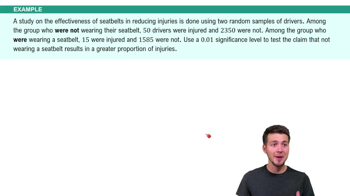
Difference in Proportions: Hypothesis Tests Example 1

Discrete vs. Continuous Data

Discrete data consist of distinct, separate values, often counted in whole numbers, such as the number of moons. Continuous data, on the other hand, can take any value within a range and are often measured, like height or temperature. Understanding whether data are discrete or continuous helps in selecting appropriate statistical methods and visualizations.
Recommended video:
Guided course
04:39
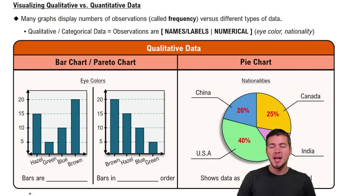
Visualizing Qualitative vs. Quantitative Data

Units of Measurement

Units of measurement provide context and meaning to numerical data, ensuring clarity and precision. In the context of the number of moons, the unit is simply 'moons,' which is a count of natural satellites orbiting each planet. Including units is crucial for interpreting data correctly and communicating findings effectively.
Recommended video:
Guided course
05:53
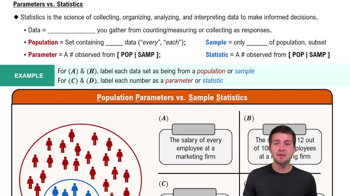
Parameters vs. Statistics
Related Practice
Textbook Question

Significant For 100 births, P(exactly 56 girls) and P(56 or more girls) Is 56 girls in 100 births a significantly high number of girls? Which probability is relevant to answering that question?

1
views
Textbook Question

Planets The planets of the solar system have the numbers of moons listed below in order from the sun. (Pluto is not included because it was uninvited from the solar system party in 2006.) Include appropriate units whenever relevant.


0 0 1 2 17 28 21 8


c. Find the mode.

d. Find the range.

Textbook Question

Identifying Probability Distributions. In Exercises 7–14, determine whether a probability distribution is given. If a probability distribution is given, find its mean and standard deviation. If a probability distribution is not given, identify the requirements that are not satisfied.

Fear of Heights The table lists results from a survey of 285 subjects who were asked, “Are you afraid of heights in tall buildings?” The results are from USA Today.

1
views
Textbook Question

Kentucky Pick 4 In the Kentucky Pick 4 lottery game, you can pay \$1 for a “straight” bet in which you select four digits with repetition allowed. If you buy only one ticket and win, your prize is \$2500.


b. If you play this game once every day, find the mean number of wins in years with exactly 365 days.

1
views
Textbook Question

Identifying Probability Distributions. In Exercises 7–14, determine whether a probability distribution is given. If a probability distribution is given, find its mean and standard deviation. If a probability distribution is not given, identify the requirements that are not satisfied.

Plane Crashes The table lists causes of fatal plane crashes with their corresponding probabilities.

1
views
Textbook Question

Tennis Challenge In a recent U.S. Open tennis tournament, there were 945 challenges made by singles players, and 255 of them resulted in referee calls that were overturned. The accompanying table lists the results by gender.


a. If 1 of the 945 challenges is randomly selected, what is the probability that it resulted in an overturned call?

1
views