Ch. 2 - Exploring Data with Tables and Graphs
Triola - Elementary Statistics 14th Edition
Triola14th EditionElementary StatisticsISBN: 9780137366446Not the one you use?Change textbook
Chapter 2, Problem 2.1.19

Freshman 15 Refer to Data Set 13 “Freshman 15” and use the second column, which lists weights (kg) in September of college freshmen. Begin with a lower class limit of 40 kg and use a class width of 10 kg. Does the distribution appear to be a normal distribution?

Verified step by step guidance
1
Step 1: Organize the data into a frequency distribution table. Start by identifying the lower class limit as 40 kg and use a class width of 10 kg. Create intervals such as 40-49, 50-59, 60-69, and so on, until all data points are covered.
Step 2: Count the number of data points (weights) that fall into each class interval. Record these frequencies in the table.
Step 3: Calculate the midpoint for each class interval. The midpoint is found using the formula: m=l+u2, where l is the lower class limit and u is the upper class limit.
Step 4: Plot a histogram using the class intervals on the x-axis and the frequencies on the y-axis. Observe the shape of the histogram to determine if it resembles a bell curve, which is characteristic of a normal distribution.
Step 5: Perform additional checks for normality, such as calculating the mean and standard deviation of the data, and comparing the frequencies to the expected frequencies of a normal distribution using a normal probability plot or statistical tests like the Shapiro-Wilk test.

Verified video answer for a similar problem:

This video solution was recommended by our tutors as helpful for the problem above.
Video duration:
3m
Was this helpful?

Key Concepts

Here are the essential concepts you must grasp in order to answer the question correctly.

Normal Distribution

A normal distribution is a probability distribution that is symmetric about the mean, showing that data near the mean are more frequent in occurrence than data far from the mean. It is characterized by its bell-shaped curve, where the mean, median, and mode are all equal. Understanding this concept is crucial for determining if the weights of freshmen follow this pattern.
Recommended video:
Guided course
09:47
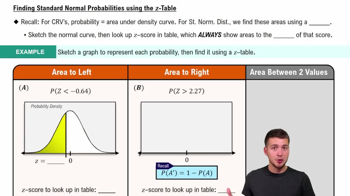
Finding Standard Normal Probabilities using z-Table

Class Intervals

Class intervals are ranges of values that are grouped together for the purpose of frequency distribution. In this case, a lower class limit of 40 kg and a class width of 10 kg means the intervals will be 40-49 kg, 50-59 kg, and so on. Analyzing data using class intervals helps in visualizing the distribution of weights and identifying patterns.
Recommended video:
06:33
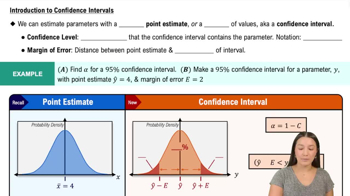
Introduction to Confidence Intervals

Descriptive Statistics

Descriptive statistics summarize and describe the main features of a dataset, including measures of central tendency (mean, median, mode) and measures of variability (range, variance, standard deviation). These statistics provide insights into the distribution of weights and help assess whether the data aligns with the characteristics of a normal distribution.
Recommended video:
Guided course
05:53
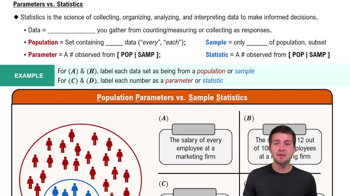
Parameters vs. Statistics
Related Practice
Textbook Question

In Exercises 13 and 14, construct the pie chart.


Box Office Boffo Use the data from Exercise 11 “Box Office Boffo.”

"Recent annual gross revenue (millions of dollars) for the leading movie studios are as follows: 20th Century Fox (1082), Buena Vista (3092), Paramount (757), Sony/Columbia (1304), Universal (1772), Warner Brothers (1941)."

Textbook Question

In Exercises 5–8, identify the class width, class midpoints, and class boundaries for the given frequency distribution. Also identify the number of individuals included in the summary. The frequency distributions are based on real data from Appendix B.

7.

3
views
Textbook Question

Analysis of Last Digits Weights of respondents were recorded as part of the California Health Interview Survey. The last digits of weights from 50 randomly selected respondents are listed below. Construct a frequency distribution with 10 classes. Based on the distribution, do the weights appear to be reported or actually measured? Does there appear to be a gap in the frequencies and, if so, how might that gap be explained? What do you know about the accuracy of the results?

2
views
Textbook Question

Births Natural births randomly selected from four hospitals in New York State occurred on the days of the week (in the order of Monday through Sunday) with these frequencies: 52, 66, 72, 57, 57, 43, 53. Does it appear that such births occur on the days of the week with equal frequency?

1
views
Textbook Question

In Exercises 9–18, construct the histograms and answer the given questions.

Chicago Commute Time Use the frequency distribution from Exercise 13 in Section 2-1 to construct a histogram. Does it appear to be the graph of data from a population with a normal distribution?

Textbook Question

Ethics There are data showing that smoking is detrimental to good health. Given that people could be helped and lives could be saved by reducing smoking, is it ethical to graph the data in a way that is misleading by exaggerating the health risks of smoking?