
Ch. 2 - Exploring Data with Tables and Graphs
Triola - Elementary Statistics 14th Edition
Triola14th EditionElementary StatisticsISBN: 9780137366446Not the one you use?Change textbook
Chapter 2, Problem 2.1.22

Analysis of Last Digits Weights of respondents were recorded as part of the California Health Interview Survey. The last digits of weights from 50 randomly selected respondents are listed below. Construct a frequency distribution with 10 classes. Based on the distribution, do the weights appear to be reported or actually measured? Does there appear to be a gap in the frequencies and, if so, how might that gap be explained? What do you know about the accuracy of the results?

Verified step by step guidance
1
Step 1: Extract the last digits from the provided data. These digits are already listed in the image, so you can directly use them for analysis.
Step 2: Construct a frequency distribution with 10 classes. Each class corresponds to a single digit (0 through 9). Count the occurrences of each digit in the data set.
Step 3: Create a table or chart to represent the frequency distribution. For example, list each digit (0-9) in one column and its frequency in the adjacent column.
Step 4: Analyze the frequency distribution to determine if the weights appear to be reported or measured. If certain digits (e.g., 0 or 5) occur disproportionately, it may suggest that the weights were rounded or reported rather than precisely measured.
Step 5: Examine the accuracy of the results and identify any gaps in the frequencies. If there is a noticeable gap or clustering around specific digits, it could indicate rounding or estimation. Discuss how this might affect the reliability of the data.

Verified video answer for a similar problem:

This video solution was recommended by our tutors as helpful for the problem above.
Video duration:
3m
Was this helpful?

Key Concepts

Here are the essential concepts you must grasp in order to answer the question correctly.

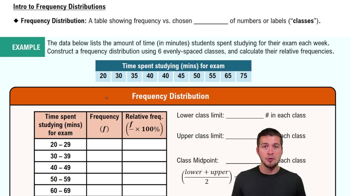
Frequency Distribution

A frequency distribution is a summary of how often each value occurs in a dataset. It organizes data into classes or intervals, allowing for easier analysis of patterns and trends. In this case, constructing a frequency distribution with 10 classes will help visualize the distribution of the last digits of weights, revealing any potential biases or anomalies in the data.
Recommended video:
Guided course
06:38
Intro to Frequency Distributions

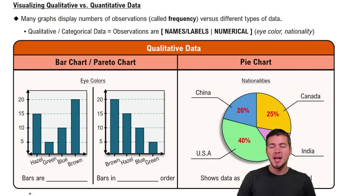
Reported vs. Measured Data

Reported data refers to values that individuals provide, which may be influenced by rounding or personal bias, while measured data is obtained through precise instruments. Analyzing the frequency distribution can help determine if the last digits of weights appear random (suggesting measurement) or exhibit patterns (indicating reporting), which can affect the reliability of the data.
Recommended video:
Guided course
04:39
Visualizing Qualitative vs. Quantitative Data

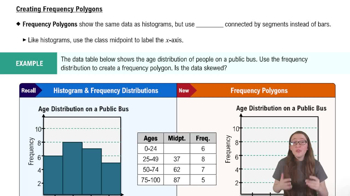
Gaps in Frequencies

Gaps in frequencies within a distribution can indicate irregularities or biases in data collection. For instance, if certain last digits are underrepresented, it may suggest that respondents rounded their weights to the nearest ten or avoided reporting certain numbers. Understanding these gaps is crucial for assessing the accuracy and validity of the survey results.
Recommended video:
04:41
Creating Frequency Polygons
Related Practice
Textbook Question

In Exercises 13 and 14, construct the pie chart.


Box Office Boffo Use the data from Exercise 11 “Box Office Boffo.”

"Recent annual gross revenue (millions of dollars) for the leading movie studios are as follows: 20th Century Fox (1082), Buena Vista (3092), Paramount (757), Sony/Columbia (1304), Universal (1772), Warner Brothers (1941)."

Textbook Question

In Exercises 5–8, identify the class width, class midpoints, and class boundaries for the given frequency distribution. Also identify the number of individuals included in the summary. The frequency distributions are based on real data from Appendix B.

7.

3
views
Textbook Question

Freshman 15 Refer to Data Set 13 “Freshman 15” and use the second column, which lists weights (kg) in September of college freshmen. Begin with a lower class limit of 40 kg and use a class width of 10 kg. Does the distribution appear to be a normal distribution?

1
views
Textbook Question

Births Natural births randomly selected from four hospitals in New York State occurred on the days of the week (in the order of Monday through Sunday) with these frequencies: 52, 66, 72, 57, 57, 43, 53. Does it appear that such births occur on the days of the week with equal frequency?

1
views
Textbook Question

In Exercises 9–18, construct the histograms and answer the given questions.

Chicago Commute Time Use the frequency distribution from Exercise 13 in Section 2-1 to construct a histogram. Does it appear to be the graph of data from a population with a normal distribution?

Textbook Question

In Exercises 9–18, construct the histograms and answer the given questions.


Old Faithful Use the frequency distribution from Exercise 15 in Section 2-1 to construct a histogram. Does it appear to be the graph of data from a population with a normal distribution?