Ch. 2 - Exploring Data with Tables and Graphs
Triola - Elementary Statistics 14th Edition
Triola14th EditionElementary StatisticsISBN: 9780137366446Not the one you use?Change textbook
Chapter 2, Problem 2.3.3

Ethics There are data showing that smoking is detrimental to good health. Given that people could be helped and lives could be saved by reducing smoking, is it ethical to graph the data in a way that is misleading by exaggerating the health risks of smoking?

Verified step by step guidance
1
Understand the ethical implications of presenting data: In statistics, it is crucial to present data accurately and without bias. Misleading graphs can distort the interpretation of data, which may lead to unethical outcomes, even if the intention is to promote a positive cause.
Consider the principles of ethical data representation: Ethical data representation involves honesty, transparency, and clarity. Misleading graphs, such as those with manipulated scales or omitted context, violate these principles and can undermine trust in statistical findings.
Evaluate the potential consequences of exaggerating risks: While the goal of reducing smoking is beneficial, exaggerating health risks through misleading graphs could lead to public mistrust in health campaigns or statistical data in general, potentially harming future efforts to promote public health.
Explore alternative approaches: Instead of exaggerating risks, focus on presenting the data accurately and effectively. Use clear and well-designed graphs that highlight the true health risks of smoking without distortion, ensuring the message is both impactful and ethical.
Reflect on professional responsibility: As statisticians or data communicators, it is our responsibility to uphold ethical standards in data presentation. Misleading graphs, even with good intentions, compromise the integrity of the field and the trust of the audience.

Verified video answer for a similar problem:

This video solution was recommended by our tutors as helpful for the problem above.
Video duration:
1m
Was this helpful?

Key Concepts

Here are the essential concepts you must grasp in order to answer the question correctly.

Ethical Considerations in Data Presentation

Ethical considerations in data presentation involve the responsibility of researchers and communicators to present data honestly and transparently. Misleading representations can distort public understanding and lead to harmful consequences. In the context of health data, exaggerating risks may induce unnecessary fear or anxiety, while downplaying risks can lead to complacency.
Recommended video:
Guided course
04:39
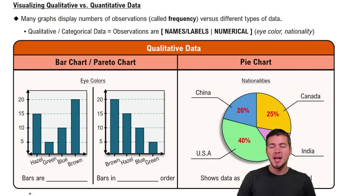
Visualizing Qualitative vs. Quantitative Data

Statistical Misrepresentation

Statistical misrepresentation occurs when data is presented in a way that misleads the audience about the true nature of the information. This can include using inappropriate scales, cherry-picking data, or employing misleading visuals. Understanding how to accurately represent data is crucial for ensuring that the audience receives a truthful interpretation of the findings.
Recommended video:
Guided course
05:53
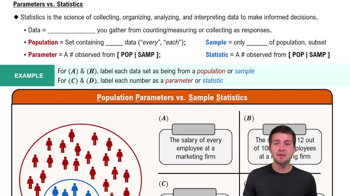
Parameters vs. Statistics

Public Health Implications

Public health implications refer to the potential effects that data presentation can have on community health behaviors and policies. Accurate data can inform effective interventions and promote healthier choices, while misleading data can hinder public health efforts. It is essential to balance the urgency of health messages with ethical data representation to foster informed decision-making.
Recommended video:
04:41
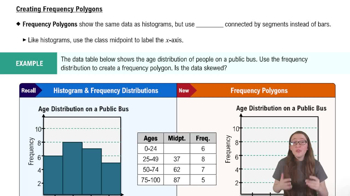
Creating Frequency Polygons
Related Practice
Textbook Question

In Exercises 13 and 14, construct the pie chart.


Box Office Boffo Use the data from Exercise 11 “Box Office Boffo.”

"Recent annual gross revenue (millions of dollars) for the leading movie studios are as follows: 20th Century Fox (1082), Buena Vista (3092), Paramount (757), Sony/Columbia (1304), Universal (1772), Warner Brothers (1941)."

Textbook Question

Exercises 29–34 involve large sets of data, so technology should be used. Complete lists of the data are not listed in Appendix B, but they can be downloaded from the website TriolaStats.com. Use the indicated data and construct the frequency distribution.


Earthquake Depths Use the depths (km) of the 600 earthquakes included in Data Set 24 “Earthquakes.” Use a class width of 10.0 km and begin with a lower class limit of 0.0 km. Does the frequency distribution appear to be a normal distribution?

1
views
Textbook Question

V and Digital Ads Listed below are amounts (billions of dollars) spent on TV and digital advertising. The amounts are listed in order by year ending with the year 2022. The last few years are projected amounts (based on data from Magna Global). Construct a graph that reveals the story that the data are trying to tell. What story does the graph depict?

TV Ads:

[Image]

Textbook Question

In Exercises 5–8, identify the class width, class midpoints, and class boundaries for the given frequency distribution. Also identify the number of individuals included in the summary. The frequency distributions are based on real data from Appendix B.

7.

3
views
Textbook Question

Freshman 15 Refer to Data Set 13 “Freshman 15” and use the second column, which lists weights (kg) in September of college freshmen. Begin with a lower class limit of 40 kg and use a class width of 10 kg. Does the distribution appear to be a normal distribution?

1
views
Textbook Question

Cell Phone Radiation If we collect a sample of cell phone radiation amounts much larger than the sample included with Exercise 3, and if our sample includes a single outlier, how will that outlier appear in a histogram?