
Ch. 10 - Correlation and Regression
Triola - Elementary Statistics 14th Edition
Triola14th EditionElementary StatisticsISBN: 9780137366446Not the one you use?Change textbook
Chapter 10, Problem 10.5.18c

Sum of Squares Criterion In addition to the value of another measurement used to assess the quality of a model is the sum of squares of the residuals. Recall from Section 10-2 that a residual is (the difference between an observed y value and the value predicted from the model). Better models have smaller sums of squares. Refer to the U.S. population data in Table 10-7.
c. Verify that according to the sum of squares criterion, the quadratic model is better than the linear model.

Verified step by step guidance
1
Identify the residuals for both the linear and quadratic models. A residual is calculated as the difference between the observed value \(y_i\) and the predicted value \(\hat{y}_i\) from the model, i.e., \(r_i = y_i - \hat{y}_i\).
Square each residual to get \(r_i^2 = (y_i - \hat{y}_i)^2\). This ensures all differences are positive and emphasizes larger errors.
Sum all the squared residuals for each model separately to get the sum of squares of residuals (SSR): \(SSR = \sum_{i=1}^n (y_i - \hat{y}_i)^2\).
Compare the SSR values for the linear and quadratic models. The model with the smaller SSR is considered better according to the sum of squares criterion because it fits the data more closely.
Conclude that if the quadratic model has a smaller SSR than the linear model, then the quadratic model is better based on this criterion.

Verified video answer for a similar problem:

This video solution was recommended by our tutors as helpful for the problem above.
Video duration:
1m
Was this helpful?

Key Concepts

Here are the essential concepts you must grasp in order to answer the question correctly.

Residuals

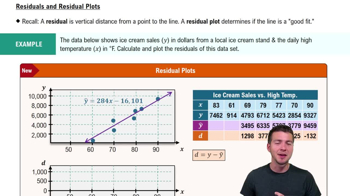
Residuals are the differences between observed values and the values predicted by a model. They measure how far off the model's predictions are from actual data points. Smaller residuals indicate a model that fits the data more closely.
Recommended video:
Guided course
07:38
Residuals and Residual Plots

Sum of Squares of Residuals (SSR)

The sum of squares of residuals is the total of each residual squared, quantifying the overall discrepancy between observed and predicted values. It is used to assess model accuracy; a lower SSR means the model predictions are closer to the actual data.
Recommended video:
Guided course
07:38
Residuals and Residual Plots

Model Comparison Using SSR

Comparing models involves evaluating their SSR values; the model with the smaller SSR is considered better because it fits the data more accurately. In this question, verifying that the quadratic model has a smaller SSR than the linear model shows it is a better fit.
Recommended video:
08:22
Tukey Test
Related Practice
Textbook Question

Notation Using the weights (lb) and highway fuel consumption amounts (mi/gal) of the 48 cars listed in Data Set 35 “Car Data” of Appendix B, we get this regression equation:

y^ = 58.9 - 0.00749x, where x represents weight.

c. What is the predictor variable?

Textbook Question

Clusters Refer to the Minitab-generated scatterplot. The four points in the lower left corner are measurements from women, and the four points in the upper right corner are from men.

Find the value of the linear correlation coefficient using all eight points. What does that value suggest about the relationship between x and y?

1
views
Textbook Question

Notation The author conducted an experiment in which the height of each student was measured in centimeters and those heights were matched with the same students’ scores on the first statistics test.

c. Does r change if the heights are converted from centimeters to inches?

3
views
Textbook Question

Exercises 1–10 are based on the following sample data consisting of costs of dinner (dollars) and the amounts of tips (dollars) left by diners. The data were collected by students of the author.

Predictions Repeat the preceding exercise assuming that the linear correlation coefficient is r = 0.132.

Textbook Question

Least-Squares Property According to the least-squares property, the regression line minimizes the sum of the squares of the residuals. Refer to the jackpot/tickets data in Table 10-1 and use the regression equation y^ = -10.9 + 0.174x that was found in Examples 1 and 2 of this section.

b. Find the sum of the squares of the residuals.

3
views
Textbook Question

Outlier Refer to the accompanying Minitab-generated scatterplot.

b. After identifying the 10 pairs of coordinates corresponding to the 10 points, find the value of the correlation coefficient r and determine whether there is a linear correlation.

1
views