Ch. 10 - Correlation and Regression
Triola - Elementary Statistics 14th Edition
Triola14th EditionElementary StatisticsISBN: 9780137366446Not the one you use?Change textbook
Chapter 10, Problem 10.2.1c

Notation Using the weights (lb) and highway fuel consumption amounts (mi/gal) of the 48 cars listed in Data Set 35 “Car Data” of Appendix B, we get this regression equation:
y^ = 58.9 - 0.00749x, where x represents weight.
c. What is the predictor variable?

Verified step by step guidance
1
Step 1: Understand the regression equation provided: y^ = 58.9 - 0.00749x. In this equation, y^ represents the predicted value of the dependent variable, and x represents the independent variable (predictor variable).
Step 2: Recall that the predictor variable is the variable used to predict or explain changes in the dependent variable. It is the input variable in the regression equation.
Step 3: Identify the role of x in the equation. Here, x is multiplied by the coefficient -0.00749, indicating that it is the variable used to predict y^.
Step 4: Note that the problem states x represents weight. Therefore, weight is the predictor variable in this regression equation.
Step 5: Conclude that the predictor variable is the independent variable, which in this case is the weight of the cars (measured in pounds).

Verified video answer for a similar problem:

This video solution was recommended by our tutors as helpful for the problem above.
Video duration:
1m
Was this helpful?

Key Concepts

Here are the essential concepts you must grasp in order to answer the question correctly.

Predictor Variable

In regression analysis, the predictor variable, also known as the independent variable, is the variable that is used to predict the value of another variable. In the given regression equation, 'x' represents the weight of the cars, which is used to predict the highway fuel consumption (y). Understanding the role of the predictor variable is essential for interpreting the relationship between the variables in the model.
Recommended video:
Guided course
07:09
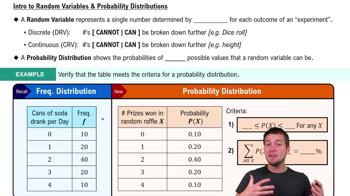
Intro to Random Variables & Probability Distributions

Regression Equation

A regression equation is a mathematical representation that describes the relationship between a dependent variable and one or more independent variables. The equation provided, y^ = 58.9 - 0.00749x, indicates how changes in the predictor variable (weight) affect the predicted value of the dependent variable (fuel consumption). This equation allows for predictions and insights into the nature of the relationship between the variables.
Recommended video:
Guided course
07:01
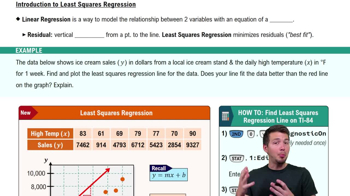
Intro to Least Squares Regression

Dependent Variable

The dependent variable, also known as the response variable, is the outcome that is being predicted or explained in a regression analysis. In this context, 'y' represents the highway fuel consumption of the cars, which depends on the weight of the cars (the predictor variable). Understanding the dependent variable is crucial for interpreting the results of the regression and assessing the impact of the predictor.
Recommended video:
Guided course
07:09
Intro to Random Variables & Probability Distributions
Related Practice
Textbook Question

Comparing Two Means Treating the data as samples from larger populations, test the claim that there is a significant difference between the mean of presidents and the mean of popes.

1
views
Textbook Question

Clusters Refer to the Minitab-generated scatterplot. The four points in the lower left corner are measurements from women, and the four points in the upper right corner are from men.

Find the value of the linear correlation coefficient using all eight points. What does that value suggest about the relationship between x and y?

1
views
Textbook Question

Notation The author conducted an experiment in which the height of each student was measured in centimeters and those heights were matched with the same students’ scores on the first statistics test.

c. Does r change if the heights are converted from centimeters to inches?

3
views
Textbook Question

Exercises 1–10 are based on the following sample data consisting of costs of dinner (dollars) and the amounts of tips (dollars) left by diners. The data were collected by students of the author.

Predictions Repeat the preceding exercise assuming that the linear correlation coefficient is r = 0.132.

Textbook Question

Least-Squares Property According to the least-squares property, the regression line minimizes the sum of the squares of the residuals. Refer to the jackpot/tickets data in Table 10-1 and use the regression equation y^ = -10.9 + 0.174x that was found in Examples 1 and 2 of this section.

b. Find the sum of the squares of the residuals.

3
views
Textbook Question

Sum of Squares Criterion In addition to the value of another measurement used to assess the quality of a model is the sum of squares of the residuals. Recall from Section 10-2 that a residual is (the difference between an observed y value and the value predicted from the model). Better models have smaller sums of squares. Refer to the U.S. population data in Table 10-7.

c. Verify that according to the sum of squares criterion, the quadratic model is better than the linear model.

1
views