Ch. 1 - Introduction to Statistics
Triola - Elementary Statistics 14th Edition
Triola14th EditionElementary StatisticsISBN: 9780137366446Not the one you use?Change textbook
Chapter 1, Problem 1.1

a

Verified step by step guidance
1
It seems like the problem statement is incomplete or missing. Please provide a complete problem statement so I can assist you effectively.
If you are looking to solve a statistical problem, ensure you include all necessary details such as data points, context, or specific statistical concepts involved.
Once the problem is clear, identify the statistical method or formula that applies to the situation. This could be measures of central tendency, probability calculations, hypothesis testing, etc.
Break down the problem into smaller parts, if possible, to make it easier to tackle. For example, if it's a probability problem, identify the sample space and events first.
Apply the relevant statistical techniques step by step, ensuring each calculation or logical deduction is clear and justified.

Key Concepts

Here are the essential concepts you must grasp in order to answer the question correctly.

Statistical Significance

Statistical significance is a measure that helps determine whether the results of a study are likely due to chance or if they reflect a true effect. It is often assessed using a p-value, where a p-value less than a predetermined threshold (commonly 0.05) indicates that the observed results are statistically significant, suggesting that the null hypothesis can be rejected.
Recommended video:
Guided course
06:34
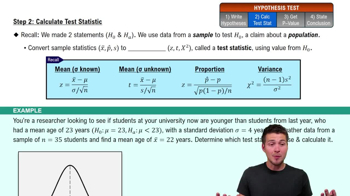
Step 2: Calculate Test Statistic

Hypothesis Testing

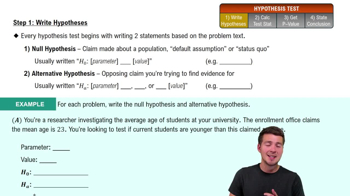
Hypothesis testing is a statistical method used to make decisions about a population based on sample data. It involves formulating a null hypothesis (H0) and an alternative hypothesis (H1), then using sample data to determine whether to reject H0 in favor of H1. This process helps researchers draw conclusions about the population from which the sample was taken.
Recommended video:
Guided course
06:21
Step 1: Write Hypotheses

Confidence Intervals

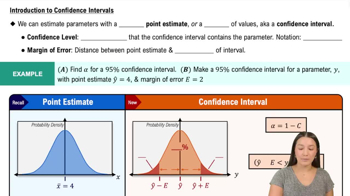
A confidence interval is a range of values, derived from sample statistics, that is likely to contain the true population parameter with a specified level of confidence, usually 95% or 99%. It provides an estimate of uncertainty around a sample statistic, allowing researchers to understand the precision of their estimates and make informed decisions based on the data.
Recommended video:
06:33
Introduction to Confidence Intervals
Related Practice
Textbook Question

In Exercises 21–28, determine which of the four levels of measurement (nominal, ordinal, interval, ratio) best describes the given data.

College Students In order to better plan for the incoming freshman class, a college dean asks each newly admitted student to identify their likely major (physics, business, math, psychology, engineering, law, etc.).

2
views
Textbook Question

In Exercises 29–32, indicate whether the observational study used is cross-sectional, retrospective, or prospective.

Heart Health Study Samples of subjects with and without heart disease were selected, and then researchers looked back in time to determine whether they took aspirin on a regular basis.

1
views
Textbook Question

In Exercises 37–44, answer the given questions, which are related to percentages.

Percentages in Advertising In an actual ad for the Club, a device used to discourage car thefts, it was stated that “The Club reduces your odds of car theft by 400%.” What is wrong with this statement?

1
views
Textbook Question

Exercises 5–8 refer to the study of an association between which ear is used for cell phone calls and whether the subject is left-handed or right-handed. The study is reported in “Hemispheric Dominance and Cell Phone Use,” by Seidman et al., JAMA Otolaryngology—Head & Neck Surgery, Vol. 139, No. 5. The study began with a survey e-mailed to 5000 people belonging to an otology online group, and 717 surveys were returned. (Otology relates to the ear and hearing.)

Experiment or Observational Study Is the study an experiment or an observational study? Explain.

1
views
Textbook Question

In Exercises 5–12, identify whether the given value is a statistic or a parameter.

Smart Phones In a Pew Research Center poll, a sample of adults in the United States was obtained, and it was found that 72% of them own smart phones.

1
views
Textbook Question

In Exercises 33–36, identify which of these designs is most appropriate for the given experiment: completely randomized design, randomized block design, or matched pairs design.


West Nile Vaccine Currently, there is no approved vaccine for the prevention of infection by West Nile virus. A clinical trial of a possible vaccine is being planned to include subjects treated with the vaccine while other subjects are given a placebo.

1
views