

Ch. 1 - Introduction to Statistics
Triola - Elementary Statistics 14th Edition
Triola14th EditionElementary StatisticsISBN: 9780137366446Not the one you use?Change textbook
Chapter 1, Problem 1.3.35

In Exercises 33–36, identify which of these designs is most appropriate for the given experiment: completely randomized design, randomized block design, or matched pairs design.


West Nile Vaccine Currently, there is no approved vaccine for the prevention of infection by West Nile virus. A clinical trial of a possible vaccine is being planned to include subjects treated with the vaccine while other subjects are given a placebo.

Verified step by step guidance
1
Understand the problem: We need to determine the most appropriate experimental design for a clinical trial involving a potential West Nile virus vaccine, where some subjects receive the vaccine and others receive a placebo.
Identify the key components of the experiment: The experiment involves two groups of subjects - one receiving the vaccine and the other receiving a placebo. The goal is to compare the effects of the vaccine against the placebo.
Consider the Completely Randomized Design: This design involves randomly assigning subjects to either the treatment group (vaccine) or the control group (placebo) without any further grouping or blocking. This is suitable when subjects are homogeneous.
Consider the Randomized Block Design: This design involves grouping subjects into blocks based on certain characteristics (e.g., age, gender) and then randomly assigning treatments within each block. This is useful when there are known sources of variability among subjects.
Consider the Matched Pairs Design: This design involves pairing subjects based on similar characteristics and then randomly assigning one subject in each pair to the treatment and the other to the control. This is effective when subjects can be closely matched on key variables.

Verified video answer for a similar problem:

This video solution was recommended by our tutors as helpful for the problem above.
Video duration:
2m
Was this helpful?

Key Concepts

Here are the essential concepts you must grasp in order to answer the question correctly.

Completely Randomized Design

A completely randomized design is a type of experimental design where all subjects are randomly assigned to different treatment groups. This method ensures that each subject has an equal chance of receiving any treatment, minimizing bias and allowing for straightforward statistical analysis of the treatment effects.
Recommended video:
Guided course
07:09
Intro to Random Variables & Probability Distributions

Randomized Block Design

A randomized block design involves grouping subjects into blocks based on certain characteristics before randomly assigning treatments within each block. This design is useful when there are known sources of variability among subjects, as it helps to control for these differences and improve the precision of the experiment.
Recommended video:
Guided course
07:09
Intro to Random Variables & Probability Distributions

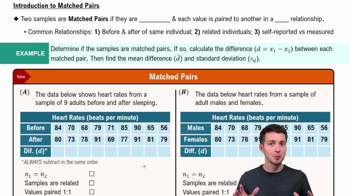
Matched Pairs Design

In a matched pairs design, subjects are paired based on similar characteristics, and each pair is split between different treatments. This design is particularly effective when comparing two treatments, as it controls for individual variability by ensuring that each treatment is applied to similar subjects, enhancing the reliability of the results.
Recommended video:
Guided course
08:33
Introduction to Matched Pairs
Related Practice
Textbook Question

In Exercises 29–32, indicate whether the observational study used is cross-sectional, retrospective, or prospective.

Marijuana Study Researchers from the National Institutes of Health want to determine the current rates of marijuana consumption among adults living in states that have legalized the use of marijuana. They conduct a survey of 500 adults in those states.

1
views
Textbook Question

In Exercises 9–20, identify which of these types of sampling is used: random, systematic, convenience, stratified, or cluster.

Highway Strength The New York State Department of Transportation evaluated the quality of the New York State Thruway by testing core samples collected at regular intervals of 1 mile.

2
views
Textbook Question

In Exercises 29–32, indicate whether the observational study used is cross-sectional, retrospective, or prospective.

Heart Health Study Samples of subjects with and without heart disease were selected, and then researchers looked back in time to determine whether they took aspirin on a regular basis.

1
views
Textbook Question

In Exercises 5–12, identify whether the given value is a statistic or a parameter.

Smart Phones In a Pew Research Center poll, a sample of adults in the United States was obtained, and it was found that 72% of them own smart phones.

1
views
Textbook Question

In Exercises 5–12, identify whether the given value is a statistic or a parameter.

Drivers According to the Federal Highway Administration, there are 212 million licensed drivers in the United States.

2
views