

Ch. 1 - Introduction to Statistics
Triola - Elementary Statistics 14th Edition
Triola14th EditionElementary StatisticsISBN: 9780137366446Not the one you use?Change textbook
Chapter 1, Problem 1.3.6

Exercises 5–8 refer to the study of an association between which ear is used for cell phone calls and whether the subject is left-handed or right-handed. The study is reported in “Hemispheric Dominance and Cell Phone Use,” by Seidman et al., JAMA Otolaryngology—Head & Neck Surgery, Vol. 139, No. 5. The study began with a survey e-mailed to 5000 people belonging to an otology online group, and 717 surveys were returned. (Otology relates to the ear and hearing.)
Experiment or Observational Study Is the study an experiment or an observational study? Explain.

Verified step by step guidance
1
Identify the key characteristics of an experiment: In an experiment, researchers manipulate one or more variables to observe the effect on another variable, often with random assignment to different conditions or groups.
Identify the key characteristics of an observational study: In an observational study, researchers observe and measure variables without manipulating them, often to find associations or correlations between variables.
Examine the study's methodology: The study involved sending a survey to 5000 people and analyzing the 717 responses received. There was no manipulation of variables or random assignment.
Determine the type of study: Since the researchers did not manipulate any variables and only collected data through surveys, this study is an observational study.
Explain the reasoning: The study is observational because it involves collecting data on existing conditions (ear used for cell phone calls and handedness) without any intervention or manipulation by the researchers.

Verified video answer for a similar problem:

This video solution was recommended by our tutors as helpful for the problem above.
Video duration:
3m
Was this helpful?

Key Concepts

Here are the essential concepts you must grasp in order to answer the question correctly.

Experiment vs Observational Study

An experiment involves manipulating one or more variables to observe the effect on another variable, often with random assignment to treatment groups. In contrast, an observational study involves observing subjects without manipulation, aiming to identify associations between variables. Understanding the distinction is crucial for determining the study's design and the validity of its conclusions.
Recommended video:
Guided course
04:39
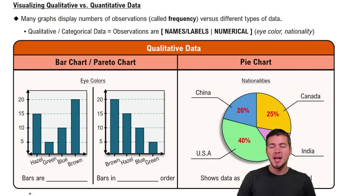
Visualizing Qualitative vs. Quantitative Data

Sampling Method

The sampling method refers to how participants are selected for a study. In this case, surveys were emailed to 5000 people from an otology online group, and 717 responses were received. This method impacts the study's representativeness and potential biases, as the sample may not reflect the broader population's characteristics.
Recommended video:
05:11
Sampling Distribution of Sample Proportion

Hemispheric Dominance

Hemispheric dominance refers to the preference for using one side of the brain over the other, often linked to handedness and sensory processing. In this study, it relates to the association between ear preference for phone calls and handedness, providing context for understanding the variables being examined and their potential interrelations.
Related Practice
Textbook Question

In Exercises 21–28, determine which of the four levels of measurement (nominal, ordinal, interval, ratio) best describes the given data.

College Students In order to better plan for the incoming freshman class, a college dean asks each newly admitted student to identify their likely major (physics, business, math, psychology, engineering, law, etc.).

2
views
Textbook Question

In Exercises 29–32, indicate whether the observational study used is cross-sectional, retrospective, or prospective.

Heart Health Study Samples of subjects with and without heart disease were selected, and then researchers looked back in time to determine whether they took aspirin on a regular basis.

1
views
Textbook Question

In Exercises 37–44, answer the given questions, which are related to percentages.

Percentages in Advertising In an actual ad for the Club, a device used to discourage car thefts, it was stated that “The Club reduces your odds of car theft by 400%.” What is wrong with this statement?

1
views
Textbook Question

In Exercises 37–44, answer the given questions, which are related to percentages.

Texting While Driving USA Today reported results from an Arity survey in which 2018 drivers were asked if they text while driving.


a. Among the respondents, 42% said that they text while driving. What is the exact value that is 42% of the number of respondents?

b. Could the result from part (a) be the actual number of respondents who said that they text while driving? Why or why not?

1
views
Textbook Question

In Exercises 5–12, identify whether the given value is a statistic or a parameter.

Smart Phones In a Pew Research Center poll, a sample of adults in the United States was obtained, and it was found that 72% of them own smart phones.

1
views