Ch. 8 - Hypothesis Testing with Two Samples
Larson - Elementary Statistics: Picturing the World 8th Edition
Larson8th EditionElementary Statistics: Picturing the WorldISBN: 9780137493470Not the one you use?Change textbook
Chapter 8, Problem 8.C6-8.1

In a survey of 4860 U.S. adults, 77% said they would date or have already dated someone whose religion was different from theirs. (Source: Pew Research Center)


Construct a 95% confidence interval for the proportion of U.S. adults who say they would date or have already dated someone whose religion was different from theirs.

Verified step by step guidance
1
Step 1: Identify the sample proportion (p̂) and the sample size (n). The sample proportion is given as 77%, or p̂ = 0.77, and the sample size is n = 4860.
Step 2: Determine the critical value (z*) for a 95% confidence level. For a 95% confidence interval, the critical value z* is approximately 1.96 (based on the standard normal distribution).
Step 3: Calculate the standard error (SE) of the sample proportion using the formula: SE = sqrt((p̂ * (1 - p̂)) / n). Substitute p̂ = 0.77 and n = 4860 into the formula.
Step 4: Compute the margin of error (ME) using the formula: ME = z* * SE. Use the critical value z* = 1.96 and the standard error calculated in Step 3.
Step 5: Construct the confidence interval by adding and subtracting the margin of error from the sample proportion. The confidence interval is given by: (p̂ - ME, p̂ + ME).

Verified video answer for a similar problem:

This video solution was recommended by our tutors as helpful for the problem above.
Video duration:
3m
Was this helpful?

Key Concepts

Here are the essential concepts you must grasp in order to answer the question correctly.

Confidence Interval

A confidence interval is a range of values, derived from sample statistics, that is likely to contain the true population parameter. In this case, it estimates the proportion of U.S. adults who would date someone of a different religion. The interval is constructed using the sample proportion and a margin of error, which accounts for variability in the sample.
Recommended video:
06:33
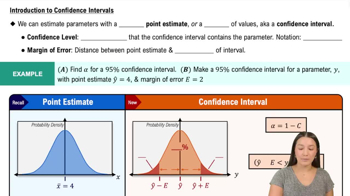
Introduction to Confidence Intervals

Sample Proportion

The sample proportion is the ratio of the number of individuals in a sample with a particular characteristic to the total number of individuals in that sample. For this question, it is calculated as 77% of the 4860 surveyed adults, which serves as the point estimate for the population proportion in the confidence interval calculation.
Recommended video:
05:11
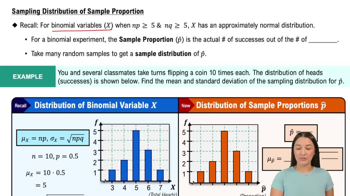
Sampling Distribution of Sample Proportion

Margin of Error

The margin of error quantifies the uncertainty associated with the sample estimate. It is calculated using the standard error of the sample proportion and a critical value from the normal distribution, which corresponds to the desired confidence level (95% in this case). This margin is added to and subtracted from the sample proportion to create the confidence interval.
Recommended video:
04:08
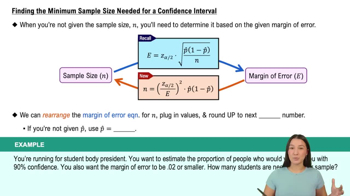
Finding the Minimum Sample Size Needed for a Confidence Interval
Related Practice
Textbook Question

Testing the Difference Between Two Means In Exercises 15–24, (a) identify the claim and state Ho and Ha, (b) find the critical value(s) and identify the rejection region(s), (c) find the standardized test statistic z, (d) decide whether to reject or fail to reject the null hypothesis, and (e) interpret the decision in the context of the original claim. Assume the samples are random and independent, and the populations are normally distributed.

ACT Mathematics and Science Scores The mean ACT mathematics score for 60 high school students is 20.2. Assume the population standard deviation is 5.7. The mean ACT science score for 75 high school students is 20.6. Assume the population standard deviation is 5.9. At α=0.01, can you reject the claim that ACT mathematics and science scores are equal? (Source: ACT, Inc.)

Textbook Question

Constructing Confidence Intervals for p1-p2 You can construct a confidence interval for the difference between two population proportions p1-p2 by using the inequality below.


[Image] Complicated mathematical formula.


In Exercises 23–26, construct the indicated confidence interval for p1-p2. Assume the samples are random and independent.


Critical Threats Repeat Exercise 25 but with a 99% confidence interval. Describe the likelihood that equal proportions of the population see cyberterrorism and the spread of infectious diseases as critical threats in the next 10 years.

Textbook Question

Find the critical value(s) for the alternative hypothesis, level of significance , and sample sizes and . Assume that the samples are random and independent, the populations are normally distributed, and the population variances are (a) equal and (b) not equal.

Ha:μ1>μ2 , α=0.01 , n1=12 , n2=15

Textbook Question

In Exercises 3–6, construct the indicated confidence interval for the population mean . Which distribution did you use to create the confidence interval?


c=0.95, x̅=3.46, s=1.63, n=16

Textbook Question

An education organization claims that the mean SAT scores for male athletes and male non-athletes at a college are different. A random sample of 26 male athletes at the college has a mean SAT score of 1189 and a standard deviation of 218. A random sample of 18 male non-athletes at the college has a mean SAT score of 1376 and a standard deviation of 186. At α=0.05, can you support the organization’s claim? Interpret the decision in the context of the original claim. Assume the populations are normally distributed and the population variances are equal.

1
views
Textbook Question

[APPLET] The annual earnings (in dollars) for 30 randomly selected locksmiths are shown below. Assume the population is normally distributed. (Adapted from Salary.com)


48,69446,85642,91261,67271,11254,861


69,45471,84159,75169,61254,28452,166


66,36048,16465,27235,25061,12765,397


58,92558,91659,01753,07045,19969,941


69,49257,08553,82952,69268,29853,792


A researcher claims that the mean annual earnings for locksmiths is \$55,000. At α=0.05, can you reject the researcher’s claim? Interpret the decision in the context of the original claim.