
Textbook Question
In Exercises 3–6, construct the indicated confidence interval for the population mean . Which distribution did you use to create the confidence interval?
c=0.90, x̅=8.21, σ=0.62, n=8
 Verified step by step guidance
 06:21
06:21
 03:33
03:33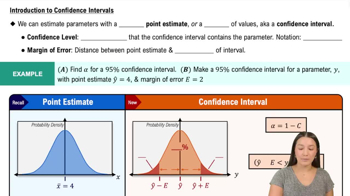 06:33
06:33In Exercises 3–6, construct the indicated confidence interval for the population mean . Which distribution did you use to create the confidence interval?
c=0.90, x̅=8.21, σ=0.62, n=8
[APPLET] The annual earnings (in dollars) for 30 randomly selected locksmiths are shown below. Assume the population is normally distributed. (Adapted from Salary.com)
48,69446,85642,91261,67271,11254,861
69,45471,84159,75169,61254,28452,166
66,36048,16465,27235,25061,12765,397
58,92558,91659,01753,07045,19969,941
69,49257,08553,82952,69268,29853,792
Construct a 95% confidence interval for the population mean annual earnings for locksmiths.
In Exercises 3–6, construct the indicated confidence interval for the population mean . Which distribution did you use to create the confidence interval?
c=0.95, x̅=3.46, s=1.63, n=16
The mean room rate for two adults for a random sample of 26 three-star hotels in Cincinnati has a sample standard deviation of \$31. Assume the population is normally distributed. (Adapted from Expedia)
Construct a 99% confidence interval for the population variance.
An education organization claims that the mean SAT scores for male athletes and male non-athletes at a college are different. A random sample of 26 male athletes at the college has a mean SAT score of 1189 and a standard deviation of 218. A random sample of 18 male non-athletes at the college has a mean SAT score of 1376 and a standard deviation of 186. At α=0.05, can you support the organization’s claim? Interpret the decision in the context of the original claim. Assume the populations are normally distributed and the population variances are equal.
In a survey of 4860 U.S. adults, 77% said they would date or have already dated someone whose religion was different from theirs. (Source: Pew Research Center)
Construct a 95% confidence interval for the proportion of U.S. adults who say they would date or have already dated someone whose religion was different from theirs.