Ch. 8 - Hypothesis Testing with Two Samples
Larson - Elementary Statistics: Picturing the World 8th Edition
Larson8th EditionElementary Statistics: Picturing the WorldISBN: 9780137493470Not the one you use?Change textbook
Chapter 8, Problem 8.4.26

Constructing Confidence Intervals for p1-p2 You can construct a confidence interval for the difference between two population proportions p1-p2 by using the inequality below.


[Image] Complicated mathematical formula.


In Exercises 23–26, construct the indicated confidence interval for p1-p2. Assume the samples are random and independent.


Critical Threats Repeat Exercise 25 but with a 99% confidence interval. Describe the likelihood that equal proportions of the population see cyberterrorism and the spread of infectious diseases as critical threats in the next 10 years.

Verified step by step guidance
1
Identify the given data: Extract the sample proportions (p̂1 and p̂2), sample sizes (n1 and n2), and the confidence level (99%) from the problem statement. Note that the confidence level will determine the critical z-value.
Calculate the standard error (SE) for the difference in proportions using the formula: SE = sqrt((p̂1(1-p̂1)/n1) + (p̂2(1-p̂2)/n2)). This formula accounts for the variability in the two sample proportions.
Determine the critical z-value for a 99% confidence interval. This value corresponds to the z-score that leaves 0.5% in each tail of the standard normal distribution (since 99% confidence leaves 1% in the tails).
Construct the confidence interval using the formula: (p̂1 - p̂2) ± z * SE. Here, (p̂1 - p̂2) is the point estimate of the difference in proportions, z is the critical z-value, and SE is the standard error calculated in step 2.
Interpret the confidence interval: If the interval includes 0, it suggests that there is no significant difference between the proportions of the two populations. If the interval does not include 0, it indicates a significant difference. Use this interpretation to describe the likelihood that equal proportions of the population see cyberterrorism and the spread of infectious diseases as critical threats.

Verified video answer for a similar problem:

This video solution was recommended by our tutors as helpful for the problem above.
Video duration:
3m
Was this helpful?

Key Concepts

Here are the essential concepts you must grasp in order to answer the question correctly.

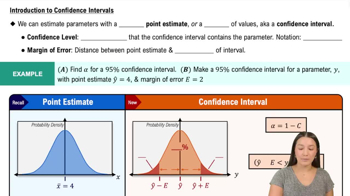
Confidence Interval

A confidence interval is a range of values, derived from sample statistics, that is likely to contain the true population parameter with a specified level of confidence, typically expressed as a percentage (e.g., 95% or 99%). It provides an estimate of uncertainty around the sample statistic, allowing researchers to infer about the population while acknowledging variability.
Recommended video:
06:33
Introduction to Confidence Intervals

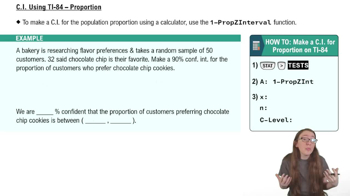
Population Proportions

Population proportions refer to the fraction of a population that exhibits a certain characteristic, denoted as p1 for one group and p2 for another. Understanding these proportions is crucial when comparing two groups, as it helps in assessing differences in characteristics, such as perceptions of threats, between populations.
Recommended video:
02:35
Finding a Confidence Interval for a Population Proportion Using a TI84

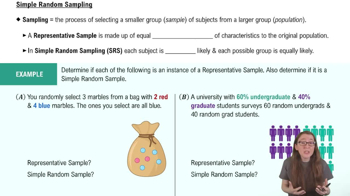
Random and Independent Samples

Random and independent samples are essential assumptions in statistical analysis, ensuring that each member of the population has an equal chance of being selected and that the selection of one individual does not influence the selection of another. This independence is vital for the validity of statistical tests and the construction of confidence intervals, as it minimizes bias and enhances the reliability of the results.
Recommended video:
04:17
Simple Random Sampling
Related Practice
Textbook Question

Testing the Difference Between Two Means In Exercises 15–24, (a) identify the claim and state Ho and Ha, (b) find the critical value(s) and identify the rejection region(s), (c) find the standardized test statistic z, (d) decide whether to reject or fail to reject the null hypothesis, and (e) interpret the decision in the context of the original claim. Assume the samples are random and independent, and the populations are normally distributed.

ACT Mathematics and Science Scores The mean ACT mathematics score for 60 high school students is 20.2. Assume the population standard deviation is 5.7. The mean ACT science score for 75 high school students is 20.6. Assume the population standard deviation is 5.9. At α=0.01, can you reject the claim that ACT mathematics and science scores are equal? (Source: ACT, Inc.)

Textbook Question

Test the claim about the difference between two population means and at the level of significance α. Assume the samples are random and independent, and the populations are normally distributed.

Claim: μ1<μ2, α=0.10, Assume (σ1)^2=(σ2)^2

Sample statistics:

x̅1=0.345, s1=0.305 , n1=11 and x̅2=0.515, s2=0.215, n2=9

1
views
Textbook Question

Independent and Dependent Samples In Exercises 5–8, classify the two samples as independent or dependent and justify your answer.

Sample 1: The IQ scores of 60 females

Sample 2: The IQ scores of 60 males

Textbook Question

Testing the Difference Between Two Means In Exercises 15–24, (a) identify the claim and state Ho and Ha, (b) find the critical value(s) and identify the rejection region(s), (c) find the standardized test statistic z, (d) decide whether to reject or fail to reject the null hypothesis, and (e) interpret the decision in the context of the original claim. Assume the samples are random and independent, and the populations are normally distributed.

ACT English and Reading Scores The mean ACT English score for 120 high school students is 19.9. Assume the population standard deviation is 7.2. The mean ACT reading score for 150 high school students is 21.2. Assume the population standard deviation is 7.1. At α=0.10, can you support the claim that ACT reading scores are higher than ACT English scores? (Source: ACT, Inc.)

Textbook Question

Find the critical value(s) for the alternative hypothesis, level of significance , and sample sizes and . Assume that the samples are random and independent, the populations are normally distributed, and the population variances are (a) equal and (b) not equal.

Ha:μ1>μ2 , α=0.01 , n1=12 , n2=15

Textbook Question

In a survey of 4860 U.S. adults, 77% said they would date or have already dated someone whose religion was different from theirs. (Source: Pew Research Center)


Construct a 95% confidence interval for the proportion of U.S. adults who say they would date or have already dated someone whose religion was different from theirs.