Ch. 7 - Hypothesis Testing with One Sample
Larson - Elementary Statistics: Picturing the World 8th Edition
Larson8th EditionElementary Statistics: Picturing the WorldISBN: 9780137493470Not the one you use?Change textbook
Chapter 7, Problem 7.2.46

Writing In a right-tailed test where P < alpha, does the standardized test statistic lie to the left or the right of the critical value? Explain your reasoning.

Verified step by step guidance
1
Understand the context of the problem: A right-tailed test is a hypothesis test where the rejection region is located in the right tail of the distribution. This means we are testing whether the test statistic is significantly greater than the critical value.
Recall the relationship between P-value and alpha: If P < alpha, it indicates that the observed data is statistically significant, and we reject the null hypothesis.
Understand the role of the critical value: The critical value is the threshold that separates the rejection region (right tail) from the non-rejection region. In a right-tailed test, any test statistic greater than the critical value falls in the rejection region.
Analyze the placement of the standardized test statistic: Since P < alpha, the test statistic must fall in the rejection region. In a right-tailed test, this means the test statistic lies to the right of the critical value.
Summarize the reasoning: The standardized test statistic lies to the right of the critical value because the P-value being less than alpha indicates that the test statistic is in the rejection region, which is located in the right tail of the distribution.

Verified video answer for a similar problem:

This video solution was recommended by our tutors as helpful for the problem above.
Video duration:
2m
Was this helpful?

Key Concepts

Here are the essential concepts you must grasp in order to answer the question correctly.

Right-tailed Test

A right-tailed test is a type of hypothesis test where the critical region for rejecting the null hypothesis is located in the right tail of the distribution. This means that we are looking for evidence that the sample statistic is significantly greater than the hypothesized parameter. In this context, if the p-value is less than the significance level (alpha), it indicates strong evidence against the null hypothesis.
Recommended video:
Guided course
06:34
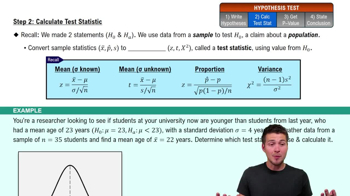
Step 2: Calculate Test Statistic

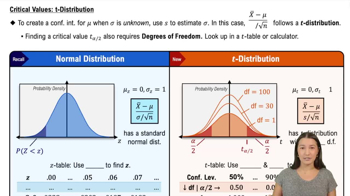
Critical Value

The critical value is a threshold that determines the boundary for rejecting the null hypothesis in a statistical test. In a right-tailed test, the critical value is located at the alpha level on the right side of the distribution. If the standardized test statistic exceeds this critical value, it suggests that the observed data is statistically significant, leading to the rejection of the null hypothesis.
Recommended video:
05:50
Critical Values: t-Distribution

Standardized Test Statistic

The standardized test statistic is a value that indicates how many standard deviations an observed value is from the mean under the null hypothesis. In a right-tailed test, if the standardized test statistic is greater than the critical value, it suggests that the observed data is significantly higher than expected. Therefore, when P < alpha, the standardized test statistic lies to the right of the critical value, indicating statistical significance.
Recommended video:
Guided course
06:34
Step 2: Calculate Test Statistic