Ch. 7 - Hypothesis Testing with One Sample
Larson - Elementary Statistics: Picturing the World 8th Edition
Larson8th EditionElementary Statistics: Picturing the WorldISBN: 9780137493470Not the one you use?Change textbook
Chapter 7, Problem 7.3.6

In Exercises 3–8, find the critical value(s) and rejection region(s) for the type of t-test with level of significance alpha and sample size n.


Right-tailed test, α=0.01, n=31

Verified step by step guidance
1
Determine the degrees of freedom (df) for the t-test. The formula for degrees of freedom is df = n - 1, where n is the sample size. In this case, df = 31 - 1 = 30.
Identify the level of significance (α). For this problem, α = 0.01, which represents the probability of rejecting the null hypothesis when it is true.
Since this is a right-tailed test, the critical value corresponds to the t-value where the area to the right under the t-distribution curve equals α. Use a t-distribution table or statistical software to find the critical t-value for df = 30 and α = 0.01.
Define the rejection region. For a right-tailed test, the rejection region is t > critical t-value. This means any test statistic greater than the critical t-value will lead to rejecting the null hypothesis.
Summarize the critical value and rejection region. Clearly state the critical t-value obtained and the corresponding rejection region (e.g., t > critical t-value).

Verified video answer for a similar problem:

This video solution was recommended by our tutors as helpful for the problem above.
Video duration:
2m
Was this helpful?

Key Concepts

Here are the essential concepts you must grasp in order to answer the question correctly.

Critical Value

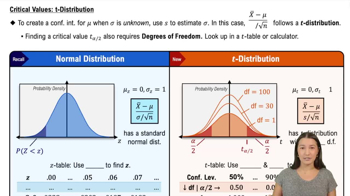
The critical value is a threshold that determines the boundary for rejecting the null hypothesis in hypothesis testing. It is derived from the chosen significance level (alpha) and the distribution of the test statistic. For a right-tailed t-test, the critical value corresponds to the point in the t-distribution where the area to the right equals alpha, indicating the cutoff for extreme values.
Recommended video:
05:50
Critical Values: t-Distribution

Rejection Region

The rejection region is the range of values for the test statistic that leads to the rejection of the null hypothesis. In a right-tailed test, this region is located to the right of the critical value. If the calculated test statistic falls within this region, it suggests that the observed data is significantly different from what is expected under the null hypothesis.
Recommended video:
Guided course
09:56
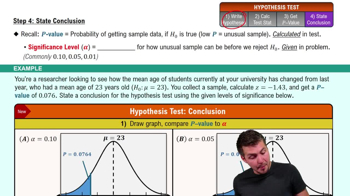
Step 4: State Conclusion

T-Test

A t-test is a statistical test used to compare the means of two groups or to assess whether a sample mean significantly differs from a known value. It is particularly useful when the sample size is small (typically n < 30) and the population standard deviation is unknown. The t-test relies on the t-distribution, which accounts for the additional uncertainty introduced by estimating the population standard deviation from the sample.
Recommended video:
05:50
Critical Values: t-Distribution
Related Practice
Textbook Question

Does failing to reject the null hypothesis mean that the null hypothesis is true? Explain.

Textbook Question

Explain how to use a t-test to test a hypothesized mean mu when sigma is unknown. What assumptions are necessary?

Textbook Question

Writing In a right-tailed test where P < alpha, does the standardized test statistic lie to the left or the right of the critical value? Explain your reasoning.

Textbook Question

Dive Duration An oceanographer claims that the mean dive duration of a North Atlantic right whale is 11.5 minutes. A random sample of 34 dive durations has a mean of 12.2 minutes and a standard deviation of 2.2 minutes. Is there enough evidence to reject the claim at α=0.10?

Textbook Question

Hypothesis Testing Using Rejection Regions In Exercises 7–12, (a) identify the claim and state H0 and Ha, (b) find the critical value(s) and identify the rejection region(s), (c) find the standardized test statistic z, (d) decide whether to reject or fail to reject the null hypothesis, and (e) interpret the decision in the context of the original claim.


Working Students An education researcher claims that 65% of full-time college students work year-round. In a random sample of 105 college students, 66 say they work year-round. At α=0.10, is there enough evidence to reject the researcher’s claim?

Textbook Question

Hypothesis Testing Using a P-Value In Exercises 33–38,


a. identify the claim and state and .

b. find the standardized test statistic z.

c. find the corresponding P-value.

d. decide whether to reject or fail to reject the null hypothesis.

e. interpret the decision in the context of the original claim.


Sprinkler Systems A manufacturer of sprinkler systems designed for fire protection claims that the average activating temperature is at least 135°F. To test this claim, you randomly select a sample of 32 systems and find the mean activation temperature to be 133°F. Assume the population standard deviation is 3.3°F. At alpha=0.10, do you have enough evidence to reject the manufacturer’s claim?