
Ch. 7 - Hypothesis Testing with One Sample
Larson - Elementary Statistics: Picturing the World 8th Edition
Larson8th EditionElementary Statistics: Picturing the WorldISBN: 9780137493470Not the one you use?Change textbook
Chapter 7, Problem 7.1.4

Does failing to reject the null hypothesis mean that the null hypothesis is true? Explain.

Verified step by step guidance
1
Understand the concept of the null hypothesis: The null hypothesis (H₀) is a statement of no effect, no difference, or no relationship in a statistical test. It is the default assumption that we test against an alternative hypothesis (H₁).
Recognize the meaning of 'failing to reject the null hypothesis': When we fail to reject H₀, it means that the evidence provided by the sample data is not strong enough to conclude that H₀ is false. This does not confirm that H₀ is true, only that we do not have sufficient evidence to reject it.
Recall the limitations of hypothesis testing: Hypothesis testing is based on probabilities and sample data, which are subject to variability. Failing to reject H₀ could occur due to insufficient sample size, low statistical power, or other factors, even if H₀ is actually false.
Understand the distinction between 'failing to reject' and 'proving true': Statistical tests are designed to assess evidence against H₀, not to prove it true. Failing to reject H₀ simply means that the data are consistent with H₀, but it does not confirm its truth with certainty.
Conclude with the correct interpretation: Failing to reject the null hypothesis means that we do not have enough evidence to support the alternative hypothesis. It is important to avoid making the incorrect assumption that H₀ is definitively true based on this outcome.

Verified video answer for a similar problem:

This video solution was recommended by our tutors as helpful for the problem above.
Video duration:
1m
Was this helpful?

Key Concepts

Here are the essential concepts you must grasp in order to answer the question correctly.

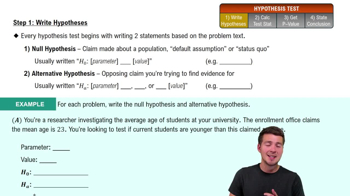
Null Hypothesis

The null hypothesis is a statement that there is no effect or no difference, and it serves as a default position in statistical testing. It is typically denoted as H0 and is tested against an alternative hypothesis (H1) that suggests a potential effect or difference. Understanding the null hypothesis is crucial for interpreting the results of hypothesis tests.
Recommended video:
Guided course
06:21
Step 1: Write Hypotheses

Statistical Significance

Statistical significance refers to the likelihood that a result or relationship observed in data is not due to random chance. In hypothesis testing, a p-value is calculated to determine if the evidence against the null hypothesis is strong enough to reject it. Failing to reject the null hypothesis does not imply that it is true; it simply indicates insufficient evidence to support the alternative hypothesis.
Recommended video:
Guided course
05:53
Parameters vs. Statistics

Type II Error

A Type II error occurs when a statistical test fails to reject a false null hypothesis, meaning that the test concludes there is no effect when, in fact, there is one. This error highlights the limitations of hypothesis testing, as failing to reject the null does not confirm the null hypothesis's truth. Understanding Type II errors is essential for evaluating the power of a statistical test and the reliability of its conclusions.
Recommended video:
Guided course
04:24
Types of Data
Related Practice
Textbook Question

Identifying the Nature of a Hypothesis Test In Exercises 37–42, state and in words and in symbols. Then determine whether the hypothesis test is left-tailed, right-tailed, or two-tailed. Explain your reasoning. Sketch a normal sampling distribution and shade the area for the P-value.


High School Graduation Rate A high school claims that its mean graduation rate is more than 97%.

Textbook Question

Hypothesis Testing Using Rejection Regions In Exercises 19–26, (a) identify the claim and state H0 and Ha, (b) find the critical value(s) and identify the rejection region(s), (c) find the standardized test statistic t, (d) decide whether to reject or fail to reject the null hypothesis, and (e) interpret the decision in the context of the original claim. Assume the population is normally distributed.


Credit Card Debt A credit reporting agency claims that the mean credit card debt in Colorado is greater than \$5540 per borrower. You want to test this claim. You find that a random sample of 30 borrowers has a mean credit card debt of \$5594 per person and a standard deviation of \$597 per person. At , can you support the claim α=0.05?

Textbook Question

Explain the difference between the z-test for μ using a P-value and the z-test for μ using rejection region(s).

Textbook Question

Explain how to use a t-test to test a hypothesized mean mu when sigma is unknown. What assumptions are necessary?

Textbook Question

Writing In a right-tailed test where P < alpha, does the standardized test statistic lie to the left or the right of the critical value? Explain your reasoning.

Textbook Question

In Exercises 3–8, find the critical value(s) and rejection region(s) for the type of t-test with level of significance alpha and sample size n.


Right-tailed test, α=0.01, n=31