
Textbook Question
Finding Critical Values for χ2 In Exercises 3–8, find the critical values χR2 and χL2 for the level of confidence c and sample size n.
c = 0.95, n = 20

 Verified step by step guidance
 05:45
05:45
 06:33
06:33 08:09
08:09Finding Critical Values for χ2 In Exercises 3–8, find the critical values χR2 and χL2 for the level of confidence c and sample size n.
c = 0.95, n = 20
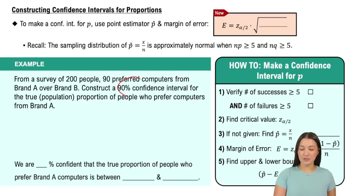
Constructing Confidence Intervals In Exercises 11 and 12, construct 90% and 95% confidence intervals for the population proportion. Interpret the results and compare the widths of the confidence intervals.
New Year’s Resolutions In a survey of 1790 U.S. adults in a recent year, 816 have a New Year’s resolution related to their health. (Adapted from Finder)
You research prices of cell phones and find that the population mean is \$431.61. In Exercise 19, does the t-value fall between -t0.95 and t0.95?
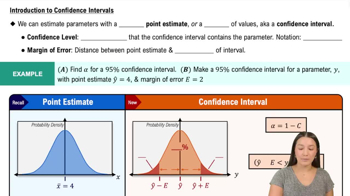
In Exercises 35–40, use the standard normal distribution or the t-distribution to construct a 95% confidence interval for the population mean. Justify your decision. If neither distribution can be used, explain why. Interpret the results.
The population standard deviation of the weights of the two-year-old males on a pediatrician’s patient list is 2.49 pounds. The mean weight of a sample of 10 of the two–year–old males is 13.68 pounds. Weights are known to be normally distributed.
In Exercises 25–28, use the confidence interval to find the margin of error and the sample mean.
(3.144, 3.176)
In Exercise 37, does it seem likely that the population mean could be greater than \$70? Explain.