
Ch. 6 - Confidence Intervals
Larson - Elementary Statistics: Picturing the World 8th Edition
Larson8th EditionElementary Statistics: Picturing the WorldISBN: 9780137493470Not the one you use?Change textbook
Chapter 6, Problem 6.1.41

In Exercise 37, does it seem likely that the population mean could be greater than \$70? Explain.

Verified step by step guidance
1
Step 1: Identify the context of the problem. The question is asking whether the population mean (μ) could be greater than \$70. This typically involves hypothesis testing or confidence interval analysis.
Step 2: Determine the statistical method to use. If the problem provides sample data (e.g., sample mean, standard deviation, and sample size), you can construct a confidence interval for the population mean or perform a hypothesis test.
Step 3: If constructing a confidence interval, calculate the margin of error using the formula: E = zα/2 ⋅ (σ/n), where zα/2 is the critical value, σ is the population standard deviation (or sample standard deviation if σ is unknown), and n is the sample size.
Step 4: If performing a hypothesis test, set up the null hypothesis H0: μ ≤ 70 and the alternative hypothesis Ha: μ > 70. Use the test statistic formula: z = ( - μ₀) / (σ/n), where is the sample mean, μ is the hypothesized mean, and σ is the standard deviation.
Step 5: Interpret the results. For a confidence interval, check if \$70 is within the interval. If it is not, it suggests the population mean could be greater than \(70. For a hypothesis test, compare the p-value to the significance level (e.g., 0.05). If the p-value is small, reject the null hypothesis, indicating that the population mean is likely greater than \)70.

Verified video answer for a similar problem:

This video solution was recommended by our tutors as helpful for the problem above.
Video duration:
3m
Was this helpful?

Key Concepts

Here are the essential concepts you must grasp in order to answer the question correctly.

Population Mean

The population mean is the average of all values in a population, representing a central point around which data points are distributed. It is a key parameter in statistics, often denoted by the symbol μ. Understanding the population mean is crucial for making inferences about the entire population based on sample data.
Recommended video:
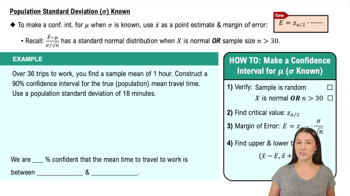
04:48
Population Standard Deviation Known

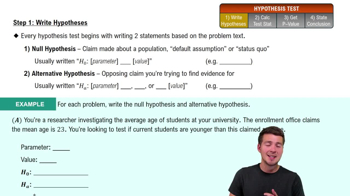
Hypothesis Testing

Hypothesis testing is a statistical method used to determine whether there is enough evidence in a sample to support a specific claim about a population parameter. In this context, one might test the hypothesis that the population mean is greater than $70. This involves comparing sample data against a null hypothesis to assess the likelihood of observing the data if the null hypothesis is true.
Recommended video:
Guided course
06:21
Step 1: Write Hypotheses

Confidence Intervals

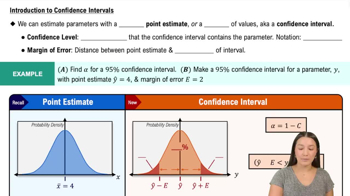
A confidence interval is a range of values, derived from sample statistics, that is likely to contain the population parameter with a specified level of confidence. For example, if a confidence interval for the population mean does not include $70, it suggests that the mean is unlikely to be greater than this value. Understanding confidence intervals helps in assessing the precision and reliability of estimates.
Recommended video:
06:33
Introduction to Confidence Intervals
Related Practice
Textbook Question

Finding p^ and q^ In Exercises 3–6, let p be the population proportion for the situation. Find point estimates of p and q.

Private Internet Browsing In a survey of 4272 U.S. adults, 1025 knew that private browsing mode only prevents someone using the same computer from seeing one’s online activities. (Adapted from Pew Research Center)

Textbook Question

In Exercises 35–40, use the standard normal distribution or the t-distribution to construct a 95% confidence interval for the population mean. Justify your decision. If neither distribution can be used, explain why. Interpret the results.

The population standard deviation of the weights of the two-year-old males on a pediatrician’s patient list is 2.49 pounds. The mean weight of a sample of 10 of the two–year–old males is 13.68 pounds. Weights are known to be normally distributed.

Textbook Question

In Exercises 25–28, use the confidence interval to find the margin of error and the sample mean.

(3.144, 3.176)

Textbook Question

Finding Critical Values for χ2 In Exercises 3–8, find the critical values χR2 and χL2 for the level of confidence c and sample size n.

c = 0.90, n = 8

Textbook Question

In Exercises 9–12, construct the indicated confidence interval for the population mean μ using the t-distribution. Assume the population is normally distributed.

c = 0.99, xbar = 24.7, s = 4.6, n = 50

Textbook Question

In Exercises 9–12, construct the indicated confidence intervals for (a) the population variance and (b) the population standard deviation . Assume the sample is from a normally distributed population.

c = 0.98, s^2 = 278.1, n =41