Ch. 6 - Confidence Intervals
Larson - Elementary Statistics: Picturing the World 8th Edition
Larson8th EditionElementary Statistics: Picturing the WorldISBN: 9780137493470Not the one you use?Change textbook
Chapter 6, Problem 6.3.12

Constructing Confidence Intervals In Exercises 11 and 12, construct 90% and 95% confidence intervals for the population proportion. Interpret the results and compare the widths of the confidence intervals.
New Year’s Resolutions In a survey of 1790 U.S. adults in a recent year, 816 have a New Year’s resolution related to their health. (Adapted from Finder)

Verified step by step guidance
1
Step 1: Identify the sample proportion (p̂) and the sample size (n). The sample proportion is calculated as p̂ = x / n, where x is the number of successes (816) and n is the total sample size (1790).
Step 2: Determine the critical z-scores for the desired confidence levels. For a 90% confidence interval, the critical z-score is approximately 1.645. For a 95% confidence interval, the critical z-score is approximately 1.96.
Step 3: Calculate the standard error (SE) of the sample proportion using the formula SE = sqrt((p̂ * (1 - p̂)) / n).
Step 4: Construct the confidence intervals using the formula: CI = p̂ ± (z * SE), where z is the critical z-score for the desired confidence level. Perform this calculation separately for the 90% and 95% confidence levels.
Step 5: Compare the widths of the confidence intervals. The width of a confidence interval is given by 2 * (z * SE). Note that the 95% confidence interval will be wider than the 90% confidence interval because a higher confidence level requires a larger margin of error.

Verified video answer for a similar problem:

This video solution was recommended by our tutors as helpful for the problem above.
Video duration:
6m
Was this helpful?

Key Concepts

Here are the essential concepts you must grasp in order to answer the question correctly.

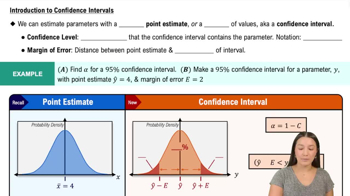
Confidence Interval

A confidence interval is a range of values, derived from sample statistics, that is likely to contain the true population parameter with a specified level of confidence, such as 90% or 95%. It provides an estimate of uncertainty around the sample proportion, indicating how much the sample result might vary if different samples were taken.
Recommended video:
06:33
Introduction to Confidence Intervals

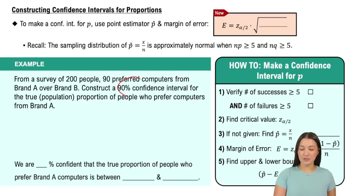
Population Proportion

The population proportion is the ratio of members of a population that have a particular characteristic, expressed as a fraction or percentage. In this context, it refers to the proportion of U.S. adults who have a New Year’s resolution related to their health, which is estimated from the sample data.
Recommended video:
05:45
Constructing Confidence Intervals for Proportions

Width of Confidence Intervals

The width of a confidence interval reflects the precision of the estimate; narrower intervals indicate more precise estimates of the population parameter. The width is influenced by the sample size and the confidence level chosen; higher confidence levels result in wider intervals, while larger sample sizes yield narrower intervals, allowing for more accurate estimates.
Recommended video:
06:33
Introduction to Confidence Intervals