
Textbook Question
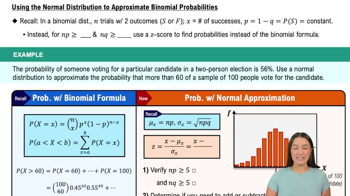
In Exercises 9–14, write the binomial probability in words. Then, use a continuity correction to convert the binomial probability to a normal distribution probability.
P(x > 65)
1
views

 Verified step by step guidance
 06:23
06:23
 08:45
08:45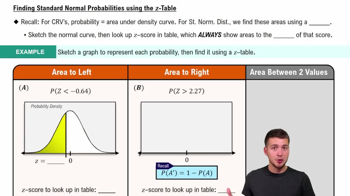 09:47
09:47In Exercises 9–14, write the binomial probability in words. Then, use a continuity correction to convert the binomial probability to a normal distribution probability.
P(x > 65)
Finding Probability In Exercises 47–56, find the indicated probability using the standard normal distribution. If convenient, use technology to find the probability.
P(- 0.89 < z < 0)
In Exercises 1–4, the sample size n, probability of success p, and probability of failure q are given for a binomial experiment. Determine whether you can use a normal distribution to approximate the distribution of x.
n=20, p=0.65, q=0.35
In Exercises 5–8, match the binomial probability statement with its corresponding normal distribution probability statement (a)–(d) after a continuity correction.
P(x≥109)
a. P(x>109.5)
b. P(x<108.5)
c. P(x<109.5)
d. P(x>108.5)
Finding a z-Score Given an Area In Exercises 23–30, find the indicated z-score.
Find the z-score that has 2.275% of the distribution’s area to its left.
In Exercises 21–24, a control chart is shown. Each chart has horizontal lines drawn at the mean mu, at mu ±2sigma, and at mu±3sigma. Determine whether the process shown is in control or out of control. Explain.
An engine part has been designed to have a diameter of 55 millimeters. The standard deviation of the process is 0.001 millimeter.