Ch. 5 - Normal Probability Distributions
Larson - Elementary Statistics: Picturing the World 8th Edition
Larson8th EditionElementary Statistics: Picturing the WorldISBN: 9780137493470Not the one you use?Change textbook
Chapter 5, Problem 5.2.24

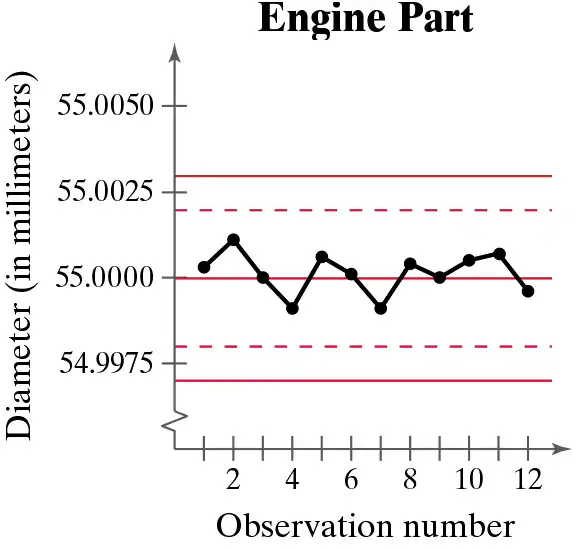
In Exercises 21–24, a control chart is shown. Each chart has horizontal lines drawn at the mean mu, at mu ±2sigma, and at mu±3sigma. Determine whether the process shown is in control or out of control. Explain.


An engine part has been designed to have a diameter of 55 millimeters. The standard deviation of the process is 0.001 millimeter.


Control chart displaying engine part diameter measurements with mean and control limits marked.

Verified step by step guidance
1
Step 1: Understand the control chart. The chart shows the mean (μ = 55 mm), upper control limits (μ + 2σ and μ + 3σ), and lower control limits (μ - 2σ and μ - 3σ). The standard deviation (σ) is given as 0.001 mm.
Step 2: Calculate the control limits. Use the formulas for the upper and lower control limits: μ ± 2σ and μ ± 3σ. For example, μ + 2σ = 55 + (2 × 0.001) = 55.002 mm, and μ - 2σ = 55 - (2 × 0.001) = 54.998 mm. Similarly, calculate μ ± 3σ.
Step 3: Analyze the data points on the control chart. Observe whether the data points fall within the control limits (μ ± 3σ). If all points are within these limits, the process is in control. If any point falls outside these limits, the process is out of control.
Step 4: Check for patterns or trends. Even if all points are within the control limits, look for systematic patterns (e.g., consecutive points above or below the mean) that might indicate a potential issue with the process.
Step 5: Conclude whether the process is in control or out of control. Based on the observations, determine if the process is stable and consistent or if corrective actions are needed.

Verified video answer for a similar problem:

This video solution was recommended by our tutors as helpful for the problem above.
Video duration:
3m
Was this helpful?

Key Concepts

Here are the essential concepts you must grasp in order to answer the question correctly.

Control Chart

A control chart is a statistical tool used to monitor the stability of a process over time. It displays data points in time order and includes control limits, typically set at the mean plus or minus two and three standard deviations. This helps identify variations in the process, distinguishing between common cause variation (in control) and special cause variation (out of control).
Recommended video:
06:10
Creating Pie Charts

Mean and Standard Deviation

The mean is the average of a set of values, representing the central tendency of the data. The standard deviation measures the dispersion or variability of the data points around the mean. In the context of control charts, these statistics are crucial for determining the control limits, which help assess whether the process is operating within acceptable parameters.
Recommended video:
Guided course
08:45
Calculating Standard Deviation

In Control vs. Out of Control

A process is considered 'in control' if the data points fall within the control limits and show no significant patterns or trends. Conversely, it is 'out of control' if points fall outside the control limits or exhibit non-random patterns, indicating potential issues in the process that require investigation. This distinction is vital for maintaining quality in manufacturing processes.
Recommended video:
Guided course
04:39
Visualizing Qualitative vs. Quantitative Data