Ch. 5 - Normal Probability Distributions
Larson - Elementary Statistics: Picturing the World 8th Edition
Larson8th EditionElementary Statistics: Picturing the WorldISBN: 9780137493470Not the one you use?Change textbook
Chapter 5, Problem 5.5.4

In Exercises 1–4, the sample size n, probability of success p, and probability of failure q are given for a binomial experiment. Determine whether you can use a normal distribution to approximate the distribution of x.
n=20, p=0.65, q=0.35

Verified step by step guidance
1
Step 1: Recall the rule for using a normal distribution to approximate a binomial distribution. The approximation is valid if both np ≥ 5 and nq ≥ 5, where n is the sample size, p is the probability of success, and q is the probability of failure.
Step 2: Calculate np by multiplying the sample size n by the probability of success p. Use the formula: np = n × p.
Step 3: Calculate nq by multiplying the sample size n by the probability of failure q. Use the formula: nq = n × q.
Step 4: Check whether both conditions np ≥ 5 and nq ≥ 5 are satisfied. If both conditions are met, the normal distribution can be used as an approximation.
Step 5: Conclude whether the normal distribution is a valid approximation based on the results of the calculations in Steps 2 and 3.

Verified video answer for a similar problem:

This video solution was recommended by our tutors as helpful for the problem above.
Video duration:
1m
Was this helpful?

Key Concepts

Here are the essential concepts you must grasp in order to answer the question correctly.

Binomial Distribution

A binomial distribution models the number of successes in a fixed number of independent Bernoulli trials, each with the same probability of success. It is characterized by two parameters: the number of trials (n) and the probability of success (p). In this context, the distribution of successes can be approximated by a normal distribution under certain conditions.
Recommended video:
Guided course
03:28
Mean & Standard Deviation of Binomial Distribution

Normal Approximation

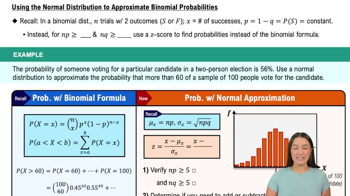
The normal approximation to the binomial distribution is applicable when both np and nq are greater than or equal to 5. This rule of thumb ensures that the binomial distribution is sufficiently symmetric and bell-shaped, allowing for the use of normal distribution techniques to estimate probabilities and make inferences about the data.
Recommended video:
06:23
Using the Normal Distribution to Approximate Binomial Probabilities

Conditions for Normal Approximation

To determine if a normal distribution can be used to approximate a binomial distribution, check the conditions np ≥ 5 and nq ≥ 5. In this case, n is the sample size, p is the probability of success, and q is the probability of failure. If both conditions are satisfied, the normal approximation is valid, simplifying calculations and analyses.
Recommended video:
06:23
Using the Normal Distribution to Approximate Binomial Probabilities