Ch. 5 - Normal Probability Distributions
Larson - Elementary Statistics: Picturing the World 8th Edition
Larson8th EditionElementary Statistics: Picturing the WorldISBN: 9780137493470Not the one you use?Change textbook
Chapter 5, Problem 5.RS.1a

Assume the machine shifts and the distribution of the amount of the compound added now has a mean of 9.96 milligrams and a standard deviation of 0.05 milligram. You select one vial and determine how much of the compound was added.


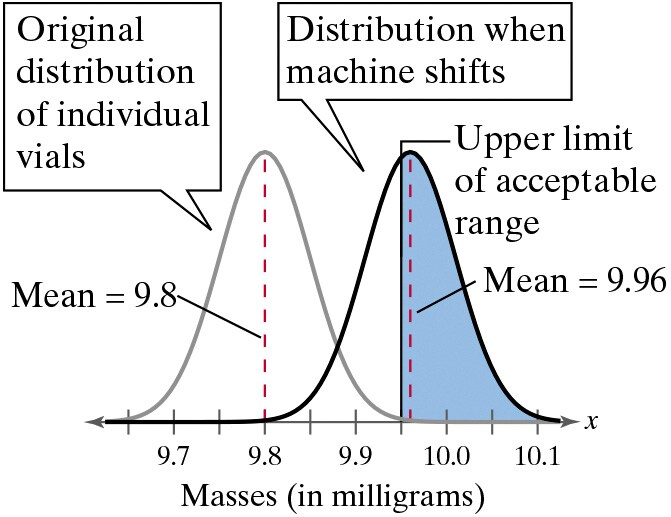
Graph comparing original and shifted distributions of vial masses, showing means and acceptable range limits.


a. What is the probability that you select a vial that is within the acceptable range (in other words, you do not detect that the machine has shifted)? (See figure.)

Verified step by step guidance
1
Step 1: Identify the parameters of the shifted distribution. The mean is given as 9.96 milligrams, and the standard deviation is 0.05 milligrams. The acceptable range is determined by the original distribution, which is centered around a mean of 9.8 milligrams.
Step 2: Define the acceptable range. Based on the figure, the upper limit of the acceptable range appears to be approximately 10.0 milligrams. This range corresponds to the original distribution's boundaries where the machine is considered to be functioning correctly.
Step 3: Standardize the values using the z-score formula. The z-score formula is \( z = \frac{x - \mu}{\sigma} \), where \( x \) is the value, \( \mu \) is the mean, and \( \sigma \) is the standard deviation. Calculate the z-scores for the lower and upper limits of the acceptable range using the shifted distribution's mean and standard deviation.
Step 4: Use the z-scores to find the cumulative probabilities. Refer to the standard normal distribution table (or use statistical software) to find the cumulative probabilities corresponding to the calculated z-scores.
Step 5: Subtract the cumulative probability of the lower limit from the cumulative probability of the upper limit. This will give the probability that a randomly selected vial falls within the acceptable range under the shifted distribution.

Verified video answer for a similar problem:

This video solution was recommended by our tutors as helpful for the problem above.
Video duration:
9m
Was this helpful?

Key Concepts

Here are the essential concepts you must grasp in order to answer the question correctly.

Normal Distribution

Normal distribution is a probability distribution that is symmetric about the mean, showing that data near the mean are more frequent in occurrence than data far from the mean. It is characterized by its bell-shaped curve, defined by its mean and standard deviation. In this context, the original and shifted distributions of the compound amounts are both normal distributions, which allows for the calculation of probabilities related to the selection of vials.
Recommended video:
06:23
Using the Normal Distribution to Approximate Binomial Probabilities

Mean and Standard Deviation

The mean is the average of a set of values, representing the central point of a distribution, while the standard deviation measures the amount of variation or dispersion from the mean. In this scenario, the mean of the shifted distribution is 9.96 milligrams, and the standard deviation is 0.05 milligrams, which helps determine the range of acceptable values for the compound added to the vials.
Recommended video:
Guided course
08:45
Calculating Standard Deviation

Probability and Z-scores

Probability quantifies the likelihood of an event occurring, often calculated using Z-scores in the context of normal distributions. A Z-score indicates how many standard deviations an element is from the mean. To find the probability that a selected vial falls within the acceptable range, one would calculate the Z-scores for the limits of that range and use the standard normal distribution to find the corresponding probabilities.
Recommended video:
Guided course
06:31
Z-Scores From Given Probability - TI-84 (CE) Calculator
Related Practice
Textbook Question

In Exercises 5 and 6, determine whether you can use a normal distribution to approximate the binomial distribution. If you can, use the normal distribution to approximate the indicated probabilities and sketch their graphs. If you cannot, explain why and use a binomial distribution to find the indicated probabilities.


A survey of U.S. undergraduates found that 37% of those attending in-state colleges would prefer to take a job in a different state after graduation. You randomly select 18 U.S. undergraduates attending in-state colleges. Find the probability that the number who would prefer to take a job in a different state after graduation is (c) at least 10. Identify any unusual events. Explain.

Textbook Question

Assume the machine shifts and is filling the vials with a mean amount of 9.96 milligrams and a standard deviation of 0.05 milligram. You select five vials and find the mean amount of compound added.


c. Which is more sensitive to a shift of parameters—an individual random selection or a randomly selected sample mean?

Textbook Question

Use technology to find the standard deviation of the set of 36 sample means. How does it compare with the standard deviation of the ages found in Exercise 5? Does this agree with the result predicted by the Central Limit Theorem?

Textbook Question

Assume the machine shifts and the distribution of the amount of the compound added now has a mean of 9.96 milligrams and a standard deviation of 0.05 milligram. You select one vial and determine how much of the compound was added.

b. You randomly select 15 vials. What is the probability that you select at least one vial that is within the acceptable range?


Textbook Question

Assume the machine shifts and is filling the vials with a mean amount of 9.96 milligrams and a standard deviation of 0.05 milligram. You select five vials and find the mean amount of compound added.


b. You randomly select three samples of five vials. What is the probability that you select at least one sample of five vials that has a mean that is within the acceptable range?


Textbook Question

Assume the machine shifts and is filling the vials with a mean amount of 9.96 milligrams and a standard deviation of 0.05 milligram. You select five vials and find the mean amount of compound added.


a. What is the probability that you select a sample of five vials that has a mean that is within the acceptable range? (See figure.)