
Ch. 5 - Normal Probability Distributions
Larson - Elementary Statistics: Picturing the World 8th Edition
Larson8th EditionElementary Statistics: Picturing the WorldISBN: 9780137493470Not the one you use?Change textbook
Chapter 5, Problem 5.RS.2c

Assume the machine shifts and is filling the vials with a mean amount of 9.96 milligrams and a standard deviation of 0.05 milligram. You select five vials and find the mean amount of compound added.
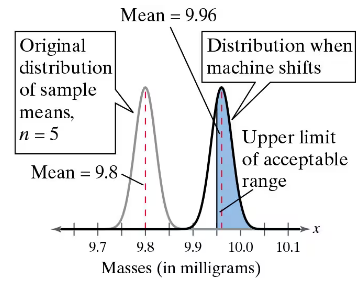
Graph comparing distributions of sample means, showing original mean of 9.8 mg and shifted mean of 9.96 mg with acceptable range.


c. Which is more sensitive to a shift of parameters—an individual random selection or a randomly selected sample mean?

Verified step by step guidance
1
Step 1: Understand the concept of sensitivity to parameter shifts. Sensitivity refers to how easily a change in the mean or standard deviation of a distribution can be detected. Individual random selections and sample means respond differently to shifts in parameters.
Step 2: Recall the Central Limit Theorem. When sampling, the mean of a sample (n > 1) is less variable than individual observations. The standard deviation of the sample mean (called the standard error) is calculated as \( \sigma_{\bar{x}} = \frac{\sigma}{\sqrt{n}} \), where \( \sigma \) is the population standard deviation and \( n \) is the sample size.
Step 3: Compare the distributions shown in the image. The original distribution of sample means (gray curve) has a mean of 9.8 milligrams and is narrower due to reduced variability (smaller standard error). The distribution when the machine shifts (blue curve) has a mean of 9.96 milligrams and is also narrower. This indicates that sample means are less variable and more sensitive to shifts in the mean compared to individual observations.
Step 4: Interpret the impact of the machine shift. A shift in the mean (from 9.8 to 9.96 milligrams) is more noticeable in the distribution of sample means because the narrower spread makes deviations from the expected mean more pronounced. Individual random selections, on the other hand, have greater variability and are less sensitive to such shifts.
Step 5: Conclude that the sample mean is more sensitive to shifts in parameters. This is because the reduced variability (smaller standard error) allows for easier detection of changes in the mean, as illustrated by the narrower and more distinct distributions in the image.

Verified video answer for a similar problem:

This video solution was recommended by our tutors as helpful for the problem above.
Video duration:
3m
Was this helpful?

Key Concepts

Here are the essential concepts you must grasp in order to answer the question correctly.

Sampling Distribution of the Mean

The sampling distribution of the mean describes the distribution of sample means obtained from a population. When samples of size n are taken, the means of these samples will form a distribution that is normally distributed, centered around the population mean, with a standard deviation known as the standard error. This concept is crucial for understanding how sample means behave and how they can be used to infer properties about the population.
Recommended video:
05:11
Sampling Distribution of Sample Proportion

Standard Deviation and Standard Error

Standard deviation measures the amount of variation or dispersion in a set of values. In the context of sampling, the standard error is the standard deviation of the sampling distribution of the mean, calculated as the population standard deviation divided by the square root of the sample size. This concept helps in understanding how much variability we can expect in sample means and is essential for hypothesis testing and confidence intervals.
Recommended video:
Guided course
08:45
Calculating Standard Deviation

Sensitivity to Parameter Shifts

Sensitivity to parameter shifts refers to how responsive a statistical measure is to changes in the underlying population parameters. In this context, a sample mean is generally more sensitive to shifts in the population mean than an individual random selection because it aggregates information from multiple observations, thus reflecting changes more clearly. Understanding this sensitivity is important for evaluating the reliability of sample means in detecting shifts in population characteristics.
Recommended video:
Guided course
05:53
Parameters vs. Statistics
Related Practice
Textbook Question

In Exercises 5 and 6, determine whether you can use a normal distribution to approximate the binomial distribution. If you can, use the normal distribution to approximate the indicated probabilities and sketch their graphs. If you cannot, explain why and use a binomial distribution to find the indicated probabilities.


A survey of U.S. undergraduates found that 37% of those attending in-state colleges would prefer to take a job in a different state after graduation. You randomly select 18 U.S. undergraduates attending in-state colleges. Find the probability that the number who would prefer to take a job in a different state after graduation is (c) at least 10. Identify any unusual events. Explain.

Textbook Question

In Exercises 1 and 2, use the normal curve to estimate the mean and standard deviation.


Textbook Question

Assume the machine shifts and the distribution of the amount of the compound added now has a mean of 9.96 milligrams and a standard deviation of 0.05 milligram. You select one vial and determine how much of the compound was added.


a. What is the probability that you select a vial that is within the acceptable range (in other words, you do not detect that the machine has shifted)? (See figure.)

Textbook Question

Assume the machine shifts and the distribution of the amount of the compound added now has a mean of 9.96 milligrams and a standard deviation of 0.05 milligram. You select one vial and determine how much of the compound was added.

b. You randomly select 15 vials. What is the probability that you select at least one vial that is within the acceptable range?


Textbook Question

Assume the machine shifts and is filling the vials with a mean amount of 9.96 milligrams and a standard deviation of 0.05 milligram. You select five vials and find the mean amount of compound added.


b. You randomly select three samples of five vials. What is the probability that you select at least one sample of five vials that has a mean that is within the acceptable range?


Textbook Question

Assume the machine shifts and is filling the vials with a mean amount of 9.96 milligrams and a standard deviation of 0.05 milligram. You select five vials and find the mean amount of compound added.


a. What is the probability that you select a sample of five vials that has a mean that is within the acceptable range? (See figure.)