Ch. 3 - Probability
Larson - Elementary Statistics: Picturing the World 8th Edition
Larson8th EditionElementary Statistics: Picturing the WorldISBN: 9780137493470Not the one you use?Change textbook
Chapter 3, Problem 3.T.1

Your dorm enters 15 out of 65 plastic numbered ducks in a duck race. The ducks are all dumped into a stream and drift to the finish line. What is the probability that three of your dorm's ducks finish first, second, and third?

Verified step by step guidance
1
Step 1: Understand the problem. You are tasked with finding the probability that three specific ducks (out of the 15 ducks entered by your dorm) finish in the top three positions in a race involving 65 ducks. This is a probability problem involving combinations and permutations.
Step 2: Calculate the total number of ways to arrange the top three positions among all 65 ducks. This is a permutation problem because the order of the ducks matters. Use the formula for permutations: P(n, r) = n! / (n - r)!, where n is the total number of ducks (65) and r is the number of positions (3). In MathML: P(n,r)=n!/(n-r)!
Step 3: Calculate the number of ways to arrange the top three positions among your dorm's 15 ducks. Again, this is a permutation problem. Use the same formula, but now n = 15 and r = 3. In MathML: P(n,r)=n!/(n-r)!
Step 4: Divide the number of favorable outcomes (arrangements of your dorm's ducks in the top three positions) by the total number of possible outcomes (arrangements of all ducks in the top three positions). This gives the probability. In MathML: P=(favorable)/(total)
Step 5: Simplify the fraction obtained in Step 4 to express the probability in its simplest form. This step involves basic arithmetic and simplification.

Verified video answer for a similar problem:

This video solution was recommended by our tutors as helpful for the problem above.
Video duration:
3m
Was this helpful?

Key Concepts

Here are the essential concepts you must grasp in order to answer the question correctly.

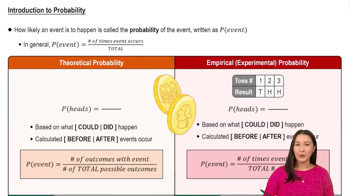
Probability

Probability is a measure of the likelihood that a particular event will occur, expressed as a number between 0 and 1. In this context, it quantifies the chance of a specific outcome—in this case, three of your dorm's ducks finishing in the top three positions of the race. The probability can be calculated using the formula: P(Event) = Number of favorable outcomes / Total number of outcomes.
Recommended video:
5:37
Introduction to Probability

Combinations and Permutations

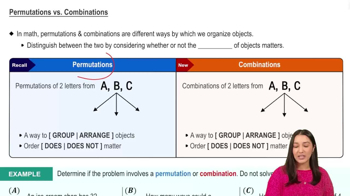
Combinations and permutations are mathematical concepts used to count the arrangements of items. Permutations consider the order of selection, which is crucial here since the finishing positions (first, second, third) matter. The number of ways to arrange 'r' items from a set of 'n' can be calculated using permutations, denoted as nPr = n! / (n-r)!, where '!' denotes factorial.
Recommended video:
03:18
Permutations vs. Combinations

Total Outcomes

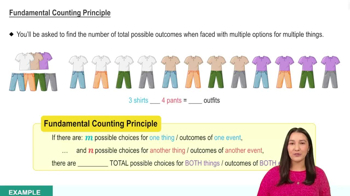
Total outcomes refer to the complete set of possible results in a probability scenario. In this duck race, the total outcomes would be the number of ways any of the 65 ducks can finish in the top three positions. This is calculated by considering all ducks and their possible arrangements, which is essential for determining the denominator in the probability calculation.
Recommended video:
04:04
Fundamental Counting Principle
Related Practice
Textbook Question

5. Use technology to randomly select two numbers from 1 to 6. Find the sum and subtract 1 to obtain a total.

a. What is the theoretical probability of each total from 1 to 11?

b. Use this procedure to select 100 totals from 1 to 11. Tally your results and compare them with the probabilities in part (a).

Textbook Question

A person's building access code is their first and last initials and four digits.

You know a person's first name only, and you know that the last digit is odd. What is the probability of guessing this person's code on the first try?

Textbook Question

7. There are 16 students giving final presentations in your history course.

b. Presentation subjects are based on the units of the course. Unit B is covered by three students, Unit C is covered by five students, and Units A and D are each covered by four students. How many presentation orders are possible when presentations on

the same unit are indistinguishable from each other?

Textbook Question

4. The table on the left shows the secondary school student enrollment levels (in thousands by grade) in Oklahoma and Texas schools in a recent year. (Source: U.S. Nation

for Education Statistics)

A student in one of the indicated grades and states is randomly selected. Find the probability of selecting a student who

d. is enrolled in Texas, given that the student is in twelfth grade.

Textbook Question

4. The table on the left shows the secondary school student enrollment levels (in thousands by grade) in Oklahoma and Texas schools in a recent year. (Source: U.S. Nation

for Education Statistics)

A student in one of the indicated grades and states is randomly selected. Find the probability of selecting a student who

a. is in ninth grade.

Textbook Question

2. How many possible variations are there in Mozart's Musical Dice Game minuet? Explain.