Ch. 3 - Probability
Larson - Elementary Statistics: Picturing the World 8th Edition
Larson8th EditionElementary Statistics: Picturing the WorldISBN: 9780137493470Not the one you use?Change textbook
Chapter 3, Problem 3.T.4d

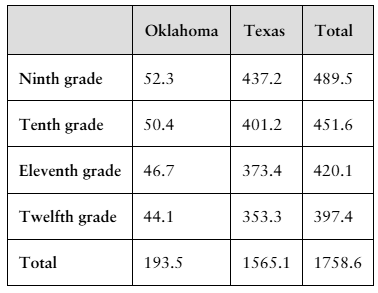
4. The table on the left shows the secondary school student enrollment levels (in thousands by grade) in Oklahoma and Texas schools in a recent year. (Source: U.S. Nation
for Education Statistics)
A student in one of the indicated grades and states is randomly selected. Find the probability of selecting a student who
d. is enrolled in Texas, given that the student is in twelfth grade.
Table showing secondary school student enrollment levels in Oklahoma and Texas by grade, with totals in thousands.

Verified step by step guidance
1
Step 1: Understand the problem. We are tasked with finding the conditional probability of selecting a student enrolled in Texas, given that the student is in twelfth grade. Conditional probability is calculated using the formula P(A|B) = P(A ∩ B) / P(B), where A is the event 'student is enrolled in Texas' and B is the event 'student is in twelfth grade'.
Step 2: Identify the relevant data from the table. From the table, the number of twelfth-grade students in Texas is 353.3 (in thousands), and the total number of twelfth-grade students across both states is 397.4 (in thousands).
Step 3: Calculate P(B), the probability of a student being in twelfth grade. This is the ratio of the total number of twelfth-grade students to the total number of students across all grades: P(B) = Total twelfth-grade students / Total students = 397.4 / 1758.6.
Step 4: Calculate P(A ∩ B), the probability of a student being enrolled in Texas and in twelfth grade. This is the ratio of the number of twelfth-grade students in Texas to the total number of students across all grades: P(A ∩ B) = Twelfth-grade students in Texas / Total students = 353.3 / 1758.6.
Step 5: Use the conditional probability formula to find P(A|B). Substitute the values from Steps 3 and 4 into the formula: P(A|B) = P(A ∩ B) / P(B).

Verified video answer for a similar problem:

This video solution was recommended by our tutors as helpful for the problem above.
Video duration:
2m
Was this helpful?

Key Concepts

Here are the essential concepts you must grasp in order to answer the question correctly.

Conditional Probability

Conditional probability refers to the likelihood of an event occurring given that another event has already occurred. In this context, it involves calculating the probability of selecting a student from Texas, given that the student is already known to be in twelfth grade. This is expressed mathematically as P(Texas | Twelfth Grade) and is calculated using the formula P(A | B) = P(A and B) / P(B).
Recommended video:
5:37
Introduction to Probability

Total Probability

Total probability is the sum of the probabilities of all possible outcomes of a random variable. In this scenario, it involves understanding the total number of twelfth-grade students enrolled in both Oklahoma and Texas, which is necessary to determine the denominator in the conditional probability calculation. The total number of twelfth graders is crucial for finding the probability of selecting a student from Texas.
Recommended video:
5:37
Introduction to Probability

Data Interpretation

Data interpretation involves analyzing and making sense of data presented in tables or graphs. In this case, it requires extracting relevant enrollment figures from the provided table to compute the required probabilities. Understanding how to read and interpret the data accurately is essential for solving the problem and ensuring that the calculations are based on the correct figures.
Recommended video:
Guided course
04:39
Visualizing Qualitative vs. Quantitative Data
Related Practice
Textbook Question

Your dorm enters 15 out of 65 plastic numbered ducks in a duck race. The ducks are all dumped into a stream and drift to the finish line. What is the probability that three of your dorm's ducks finish first, second, and third?
Textbook Question

A person's building access code is their first and last initials and four digits.

You know a person's first name only, and you know that the last digit is odd. What is the probability of guessing this person's code on the first try?

Textbook Question

7. There are 16 students giving final presentations in your history course.

b. Presentation subjects are based on the units of the course. Unit B is covered by three students, Unit C is covered by five students, and Units A and D are each covered by four students. How many presentation orders are possible when presentations on

the same unit are indistinguishable from each other?

Textbook Question

You work in the security department of a bank’s website. To access their accounts, customers of the bank must create an 8-digit password. It is your job to determine the password requirements for these accounts. Security guidelines state that for the website to be secure, the probability that an 8-digit password is guessed on one try must be less than 1/60^8, assuming all passwords are equally likely.

Your job is to use the probability techniques you have learned in this chapter to decide what requirements a customer must meet when choosing a password, including what sets of characters are allowed, so that the website is secure according to the security guidelines.

3. For additional security, each customer creates a 5-digit PIN (personal identification number). The table on the right shows the 10 most commonly chosen 5-digit PINs. From the table, you can see that more than a third of all 5-digit PINs could be guessed by trying these 10 numbers. To discourage customers from using predictable PINs, you consider prohibiting PINs that use the same digit more than once.

b. Would you decide to prohibit PINs that use the same digit more than once? Explain.

Textbook Question

4. The table on the left shows the secondary school student enrollment levels (in thousands by grade) in Oklahoma and Texas schools in a recent year. (Source: U.S. Nation

for Education Statistics)

A student in one of the indicated grades and states is randomly selected. Find the probability of selecting a student who

a. is in ninth grade.

Textbook Question

You work in the security department of a bank’s website. To access their accounts, customers of the bank must create an 8-digit password. It is your job to determine the password requirements for these accounts. Security guidelines state that for the website to be secure, the probability that an 8-digit password is guessed on one try must be less than 1/60^8, assuming all passwords are equally likely.

Your job is to use the probability techniques you have learned in this chapter to decide what requirements a customer must meet when choosing a password, including what sets of characters are allowed, so that the website is secure according to the security guidelines.

2. Answering the Question

a. What password requirements would you set? What characters would be allowed?

1
views