Ch. 3 - Probability
Larson - Elementary Statistics: Picturing the World 8th Edition
Larson8th EditionElementary Statistics: Picturing the WorldISBN: 9780137493470Not the one you use?Change textbook
Chapter 3, Problem 3.RE.42

In Exercises 41-44, perform the indicated calculation.
42. 8P6

Verified step by step guidance
1
Step 1: Understand the notation 8P6. This represents a permutation, which is the number of ways to arrange 6 items out of 8 in a specific order. The formula for permutations is given by P(n, r) = n! / (n - r)!, where n is the total number of items, and r is the number of items to arrange.
Step 2: Identify the values of n and r in the problem. Here, n = 8 and r = 6.
Step 3: Substitute the values of n and r into the permutation formula. This gives P(8, 6) = 8! / (8 - 6)!. Simplify the denominator to get P(8, 6) = 8! / 2!.
Step 4: Expand the factorials in the numerator and denominator. Recall that 8! = 8 × 7 × 6 × 5 × 4 × 3 × 2 × 1 and 2! = 2 × 1. Cancel out the common terms in the numerator and denominator.
Step 5: Multiply the remaining terms in the numerator after cancellation to compute the result. This will give you the total number of permutations for arranging 6 items out of 8.

Verified video answer for a similar problem:

This video solution was recommended by our tutors as helpful for the problem above.
Video duration:
1m
Was this helpful?

Key Concepts

Here are the essential concepts you must grasp in order to answer the question correctly.

Permutations

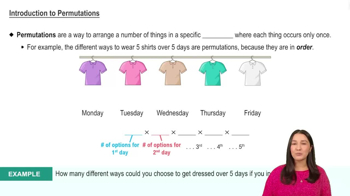
Permutations refer to the different ways of arranging a set of items where the order matters. The notation nPr represents the number of ways to choose r items from a total of n items, considering the arrangement. For example, if you have 3 letters A, B, and C, the permutations of choosing 2 letters would include AB, AC, BA, BC, CA, and CB.
Recommended video:
07:11
Introduction to Permutations

Factorial

A factorial, denoted as n!, is the product of all positive integers up to n. It is a fundamental concept in combinatorics, used to calculate permutations and combinations. For instance, 5! equals 5 × 4 × 3 × 2 × 1 = 120. Factorials grow rapidly, making them essential for counting arrangements and selections.
Recommended video:
05:22
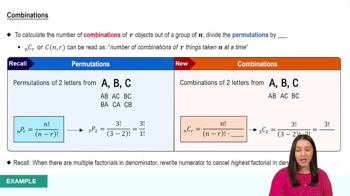
Combinations

Calculation of Permutations

The formula for calculating permutations is given by nPr = n! / (n - r)!. This formula allows you to determine the number of ways to arrange r items from a total of n items. In the case of 8P6, you would calculate it as 8! / (8 - 6)! = 8! / 2!, which simplifies the computation by reducing the factorial terms.
Recommended video:
07:11
Introduction to Permutations
Related Practice
Textbook Question

In Exercises 1-4, identify the sample space of the probability experiment and determine the number of outcomes in the event. Draw a tree diagram when appropriate.

3. Experiment: Choosing a month of the year

Event: Choosing a month that begins with the letter J

Textbook Question

In Exercises 25 and 26, determine whether the events are mutually exclusive. Explain your reasoning.

25. Event A: Randomly select a red jelly bean from a jar.

Event B: Randomly select a yellow jelly bean from the jar.

Textbook Question

In Exercises 7-12, classify the statement as an example of classical probability, empirical probability, or subjective probability. Explain your reasoning.

8. The probability of randomly selecting five cards of the same suit from a standard deck of 52 playing cards is about 0.002.

Textbook Question

Telephone Numbers The telephone numbers for a region of Pennsylvania have an area code of 570. The next seven digits represent the local telephone numbers for that region. These cannot begin with a 0 or 1. In Exercises 15 and 16, assume your cousin lives within the given area code.

16. What is the probability of not randomly generating your cousin's telephone number on the first try?

Textbook Question

In Exercises 41-44, perform the indicated calculation.

44. (5C3)/(10C3)

Textbook Question

In Exercises 19-22, determine whether the events are independent or dependent. Explain your reasoning.

19. Tossing a coin four times and getting four heads, and then tossing it a fifth time and getting a head