Ch. 3 - Probability
Larson - Elementary Statistics: Picturing the World 8th Edition
Larson8th EditionElementary Statistics: Picturing the WorldISBN: 9780137493470Not the one you use?Change textbook
Chapter 3, Problem 3.RE.16

Telephone Numbers The telephone numbers for a region of Pennsylvania have an area code of 570. The next seven digits represent the local telephone numbers for that region. These cannot begin with a 0 or 1. In Exercises 15 and 16, assume your cousin lives within the given area code.
16. What is the probability of not randomly generating your cousin's telephone number on the first try?

Verified step by step guidance
1
Step 1: Understand the structure of the telephone number. The area code is fixed as 570, and the local telephone number consists of 7 digits. The first digit of the local number cannot be 0 or 1, leaving 8 possible choices (2 through 9). The remaining 6 digits can each be any digit from 0 to 9, giving 10 choices per digit.
Step 2: Calculate the total number of possible telephone numbers in the region. Multiply the number of choices for the first digit (8) by the number of choices for each of the remaining 6 digits (10^6). This gives the total number of valid telephone numbers.
Step 3: Recognize that your cousin has exactly one specific telephone number. Therefore, the probability of randomly generating your cousin's number on the first try is the reciprocal of the total number of valid telephone numbers, which is 1 divided by the total calculated in Step 2.
Step 4: To find the probability of NOT randomly generating your cousin's telephone number on the first try, subtract the probability of generating their number from 1. This is expressed as: P(not cousin's number) = 1 - P(cousin's number).
Step 5: Substitute the probability of generating your cousin's number (from Step 3) into the formula from Step 4 to compute the final probability of not generating your cousin's number on the first try.

Verified video answer for a similar problem:

This video solution was recommended by our tutors as helpful for the problem above.
Video duration:
3m
Was this helpful?

Key Concepts

Here are the essential concepts you must grasp in order to answer the question correctly.

Probability

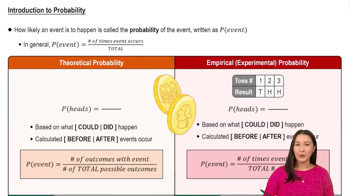
Probability is a measure of the likelihood that a particular event will occur, expressed as a number between 0 and 1. In this context, it quantifies the chance of not generating a specific telephone number when randomly selecting from all possible numbers in the area code. Understanding probability helps in assessing outcomes in uncertain situations.
Recommended video:
5:37
Introduction to Probability

Sample Space

The sample space is the set of all possible outcomes in a probability experiment. For the telephone numbers in the 570 area code, the sample space includes all valid seven-digit combinations that do not start with 0 or 1. Identifying the sample space is crucial for calculating probabilities accurately.
Recommended video:
05:11
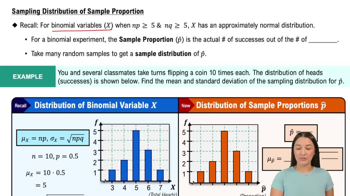
Sampling Distribution of Sample Proportion

Complementary Events

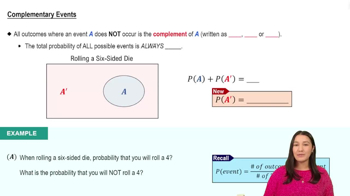
Complementary events are pairs of outcomes where one event occurs if and only if the other does not. In this scenario, the event of generating your cousin's telephone number and the event of not generating it are complementary. Understanding this relationship allows for easier calculation of probabilities, as the probability of an event and its complement always sum to 1.
Recommended video:
4:23
Complementary Events