Ch. 3 - Probability
Larson - Elementary Statistics: Picturing the World 8th Edition
Larson8th EditionElementary Statistics: Picturing the WorldISBN: 9780137493470Not the one you use?Change textbook
Chapter 3, Problem 3.RE.25

In Exercises 25 and 26, determine whether the events are mutually exclusive. Explain your reasoning.
25. Event A: Randomly select a red jelly bean from a jar.
Event B: Randomly select a yellow jelly bean from the jar.

Verified step by step guidance
1
Understand the concept of mutually exclusive events: Two events are mutually exclusive if they cannot occur at the same time. In other words, the occurrence of one event means the other cannot happen.
Identify the events in the problem: Event A is selecting a red jelly bean, and Event B is selecting a yellow jelly bean.
Consider the scenario: If you randomly select one jelly bean from the jar, it can only be one color at a time. A single jelly bean cannot simultaneously be red and yellow.
Analyze the relationship between the events: Since selecting a red jelly bean (Event A) and selecting a yellow jelly bean (Event B) cannot happen at the same time, the two events are mutually exclusive.
Conclude your reasoning: Based on the analysis, the events are mutually exclusive because the selection of one color excludes the possibility of selecting the other color in a single draw.

Verified video answer for a similar problem:

This video solution was recommended by our tutors as helpful for the problem above.
Video duration:
1m
Was this helpful?

Key Concepts

Here are the essential concepts you must grasp in order to answer the question correctly.

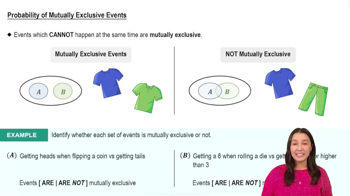
Mutually Exclusive Events

Mutually exclusive events are those that cannot occur at the same time. In probability, if one event happens, the other cannot. For example, when rolling a die, the events of rolling a 2 and rolling a 5 are mutually exclusive because both cannot happen simultaneously.
Recommended video:
5:14
Probability of Mutually Exclusive Events

Sample Space

The sample space is the set of all possible outcomes of a random experiment. In the context of selecting jelly beans, the sample space includes all the different colored jelly beans in the jar. Understanding the sample space helps in determining the likelihood of various events occurring.
Recommended video:
05:11
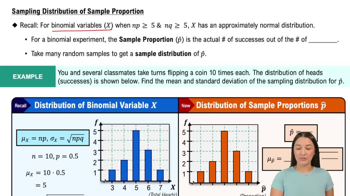
Sampling Distribution of Sample Proportion

Probability

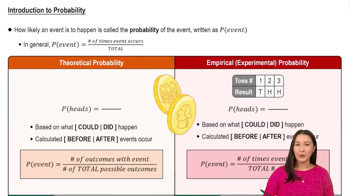
Probability is a measure of the likelihood that an event will occur, expressed as a number between 0 and 1. In this scenario, calculating the probability of selecting a red or yellow jelly bean involves understanding how many of each color are present in the jar relative to the total number of jelly beans.
Recommended video:
5:37
Introduction to Probability