Ch. 2 - Descriptive Statistics
Larson - Elementary Statistics: Picturing the World 8th Edition
Larson8th EditionElementary Statistics: Picturing the WorldISBN: 9780137493470Not the one you use?Change textbook
Chapter 2, Problem 2.3.66a

Extending Concepts


Trimmed Mean To find the 10% trimmed mean of a data set, order the data, delete the lowest 10% of the entries and the highest 10% of the entries, and find the mean of the remaining entries.


a. Find the 10% trimmed mean for the data in Exercise 65.

Verified step by step guidance
1
Order the data set in ascending order to ensure the values are arranged from smallest to largest.
Determine the number of data points to trim from both the lowest and highest ends. This is calculated as 10% of the total number of data points. If the result is not an integer, round to the nearest whole number.
Remove the lowest 10% of the data points and the highest 10% of the data points from the ordered list.
Calculate the mean of the remaining data points by summing them and dividing by the number of remaining data points.
Express the result as the 10% trimmed mean of the data set.

Verified video answer for a similar problem:

This video solution was recommended by our tutors as helpful for the problem above.
Video duration:
2m
Was this helpful?

Key Concepts

Here are the essential concepts you must grasp in order to answer the question correctly.

Trimmed Mean

A trimmed mean is a statistical measure that reduces the influence of outliers by removing a specified percentage of the lowest and highest values from a data set before calculating the mean. For example, a 10% trimmed mean involves discarding the lowest 10% and the highest 10% of data points, which helps provide a more robust average that better represents the central tendency of the remaining data.
Recommended video:
Guided course
04:52
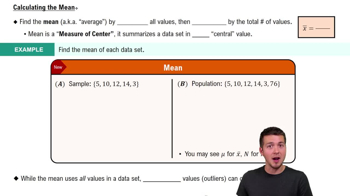
Calculating the Mean

Data Ordering

Data ordering is the process of arranging data points in a specific sequence, typically from lowest to highest. This step is crucial for calculating the trimmed mean, as it allows for the systematic removal of the specified percentage of extreme values, ensuring that the calculation of the mean is based on a representative subset of the data.
Recommended video:
Guided course
04:39
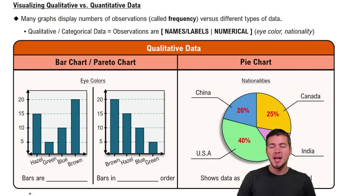
Visualizing Qualitative vs. Quantitative Data

Mean Calculation

The mean, or average, is a fundamental statistical measure calculated by summing all values in a data set and dividing by the number of values. In the context of a trimmed mean, the mean is computed only from the data points that remain after the specified percentage of extreme values has been removed, providing a more accurate reflection of the central tendency of the data.
Recommended video:
Guided course
04:52
Calculating the Mean
Related Practice
Textbook Question

Using the Empirical Rule In Exercises 29–34, use the Empirical Rule.


Use the sample statistics from Exercise 29 and assume the number of vehicles in the sample is 75.


a. Estimate the number of vehicles whose speeds are between 63 miles per hour and 71 miles per hour.

Textbook Question

Using and Interpreting Concepts


Using and Interpreting Concepts Finding Quartiles, Interquartile Range, and Outliers In Exercises 11 and 12,

(a) find the quartiles


56 63 51 60 57 60 60 54 63 59 80 63 60 62 65

Textbook Question

Yoga Classes The data sets at the left show the ages of all participants in two yoga classes.

a. Make a back-to-back stem-and-leaf plot as described in Exercise 41 to display the data.

Textbook Question

Song Lengths Side-by-side box-and-whisker plots can be used to compare two or more different data sets. Each box-and-whisker plot is drawn on the same number line to compare the data sets more easily. The lengths (in seconds) of songs played at two different concerts are shown.

a. Describe the shape of each distribution. Which concert has less variation in song lengths?

Textbook Question

Extending Concepts


Data Analysis Students in an experimental psychology class did research on depression as a sign of stress. A test was administered to a sample of 30 students. The scores are shown in the table at the left.


" style="" width="275">


a. Find the mean and the median of the data.

Textbook Question

U.S. Trade Deficits The table at the left shows the U.S. trade deficits (in billions of dollars) with 18 countries in 2020. (Source: U.S. Department of Commerce)


" style="" width="280">


a. Find the mean and the median of the trade deficits.