Ch. 2 - Descriptive Statistics
Larson - Elementary Statistics: Picturing the World 8th Edition
Larson8th EditionElementary Statistics: Picturing the WorldISBN: 9780137493470Not the one you use?Change textbook
Chapter 2, Problem 2.2.42a

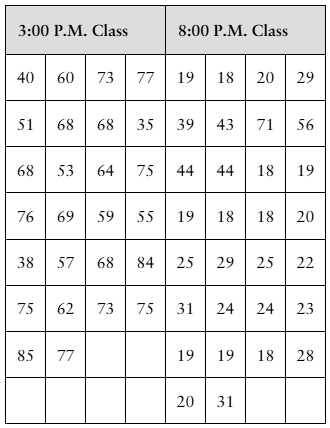
Yoga Classes The data sets at the left show the ages of all participants in two yoga classes.
tab
a. Make a back-to-back stem-and-leaf plot as described in Exercise 41 to display the data.

Verified step by step guidance
1
Step 1: Understand the concept of a back-to-back stem-and-leaf plot. This type of plot is used to compare two data sets side by side. The 'stem' represents the leading digits (e.g., tens place), while the 'leaves' represent the trailing digits (e.g., ones place). The stems are shared between the two data sets, with one set's leaves displayed to the left and the other's to the right.
Step 2: Organize the data for both classes into stems and leaves. For example, for the 3:00 P.M. class, the ages include numbers like 40, 60, 73, etc. The stems will be the tens digits (e.g., 4, 6, 7, etc.), and the leaves will be the ones digits (e.g., 0, 0, 3, etc.). Similarly, for the 8:00 P.M. class, organize the ages into stems and leaves.
Step 3: Create a shared stem column. Write the stems in ascending order (e.g., 1, 2, 3, etc.) in the center of the plot. The leaves for the 3:00 P.M. class will be displayed to the left of the stems, and the leaves for the 8:00 P.M. class will be displayed to the right.
Step 4: Populate the back-to-back stem-and-leaf plot. For each stem, list the leaves for the 3:00 P.M. class on the left side and the leaves for the 8:00 P.M. class on the right side. Ensure the leaves are ordered numerically within each stem.
Step 5: Review the completed plot for accuracy. Verify that all data points are included and correctly placed. The plot should visually compare the distribution of ages between the two yoga classes, allowing for easy interpretation of differences or similarities.

Verified video answer for a similar problem:

This video solution was recommended by our tutors as helpful for the problem above.
Video duration:
2m
Was this helpful?

Key Concepts

Here are the essential concepts you must grasp in order to answer the question correctly.

Stem-and-Leaf Plot

A stem-and-leaf plot is a method of displaying quantitative data in a graphical format, similar to a histogram, to retain the original data values while showing their distribution. Each number is split into a 'stem' (the leading digit or digits) and a 'leaf' (the trailing digit). This allows for easy visualization of the data's shape and helps identify the distribution, central tendency, and spread.
Recommended video:
06:23
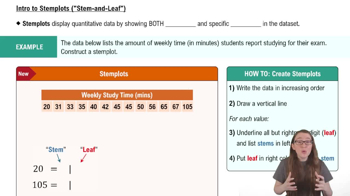
Creating Stemplots

Data Distribution

Data distribution refers to how values are spread or arranged across a dataset. Understanding the distribution helps in identifying patterns, trends, and anomalies within the data. Common distributions include normal, skewed, and uniform distributions, which can be visualized using plots like histograms or stem-and-leaf plots, providing insights into the data's characteristics.
Recommended video:
4:01
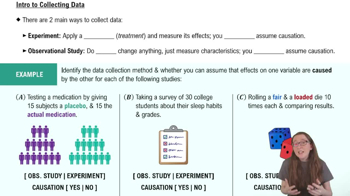
Introduction to Collecting Data

Comparative Analysis

Comparative analysis involves evaluating two or more datasets to identify similarities, differences, and trends. In the context of the yoga classes, comparing the ages of participants in the 3:00 P.M. and 8:00 P.M. classes can reveal insights about the demographics of each class. This analysis can be effectively visualized using back-to-back stem-and-leaf plots, facilitating a clear comparison of the two groups.
Recommended video:
Guided course
04:48
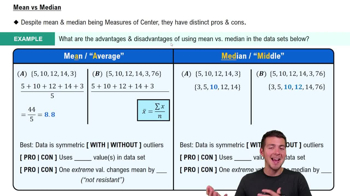
Comparing Mean vs. Median
Related Practice
Textbook Question

Using the Empirical Rule In Exercises 29–34, use the Empirical Rule.


Use the sample statistics from Exercise 29 and assume the number of vehicles in the sample is 75.


a. Estimate the number of vehicles whose speeds are between 63 miles per hour and 71 miles per hour.

Textbook Question

Extending Concepts


Trimmed Mean To find the 10% trimmed mean of a data set, order the data, delete the lowest 10% of the entries and the highest 10% of the entries, and find the mean of the remaining entries.


a. Find the 10% trimmed mean for the data in Exercise 65.

Textbook Question

Using and Interpreting Concepts


Using and Interpreting Concepts Finding Quartiles, Interquartile Range, and Outliers In Exercises 11 and 12,

(a) find the quartiles


56 63 51 60 57 60 60 54 63 59 80 63 60 62 65

Textbook Question

Song Lengths Side-by-side box-and-whisker plots can be used to compare two or more different data sets. Each box-and-whisker plot is drawn on the same number line to compare the data sets more easily. The lengths (in seconds) of songs played at two different concerts are shown.

a. Describe the shape of each distribution. Which concert has less variation in song lengths?

Textbook Question

Extending Concepts


Data Analysis Students in an experimental psychology class did research on depression as a sign of stress. A test was administered to a sample of 30 students. The scores are shown in the table at the left.


" style="" width="275">


a. Find the mean and the median of the data.

Textbook Question

Drawing a Box-and-Whisker Plot In Exercises 15–18,

(a) find the five-number summary


4 7 7 5 2 9 7 6 8 5 8 4 1 5 2 8 7 6 6 9

1
views