Ch. 2 - Descriptive Statistics
Larson - Elementary Statistics: Picturing the World 8th Edition
Larson8th EditionElementary Statistics: Picturing the WorldISBN: 9780137493470Not the one you use?Change textbook
Chapter 2, Problem 2.3.62d

Extending Concepts


Golf The distances (in yards) for nine holes of a golf course are listed.
336 393 408 522 147 504 177 375 360


d. Use your results from part (c) to explain how to quickly find the mean and the median of the original data set when the distances are converted to inches.

Verified step by step guidance
1
Step 1: Recall the conversion factor between yards and inches. Since 1 yard equals 36 inches, any distance in yards can be converted to inches by multiplying it by 36.
Step 2: To find the mean of the original data set in inches, note that the mean of a data set is the sum of all values divided by the number of values. When converting the distances to inches, each value is multiplied by 36. Therefore, the mean in inches can be calculated by multiplying the mean in yards by 36.
Step 3: To find the median of the original data set in inches, recall that the median is the middle value when the data is ordered. Since converting to inches involves multiplying each value by 36, the relative order of the data does not change. Thus, the median in inches is simply the median in yards multiplied by 36.
Step 4: Summarize the key insight: When converting a data set from one unit to another by multiplying by a constant, both the mean and the median are scaled by the same constant. This allows for quick computation without recalculating from scratch.
Step 5: Apply this understanding to the given data set. Use the mean and median from part (c) (in yards) and multiply each by 36 to find the mean and median in inches.

Verified video answer for a similar problem:

This video solution was recommended by our tutors as helpful for the problem above.
Video duration:
2m
Was this helpful?

Key Concepts

Here are the essential concepts you must grasp in order to answer the question correctly.

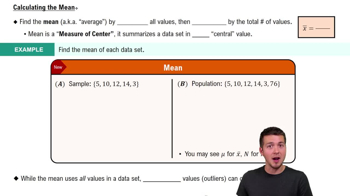
Mean

The mean, or average, is calculated by summing all values in a data set and dividing by the number of values. In this case, to find the mean of the golf hole distances in inches, you would first convert each distance from yards to inches (1 yard = 36 inches), sum these converted values, and then divide by the total number of holes.
Recommended video:
Guided course
04:52
Calculating the Mean

Median

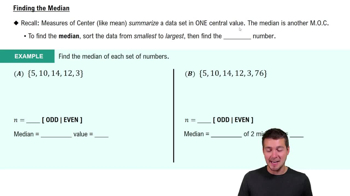
The median is the middle value of a data set when arranged in ascending order. If the number of observations is odd, the median is the middle number; if even, it is the average of the two middle numbers. For the golf distances converted to inches, you would first convert the values, sort them, and then identify the median based on their position in the ordered list.
Recommended video:
Guided course
03:26
Calculating the Median

Unit Conversion

Unit conversion involves changing a measurement from one unit to another, which is essential when comparing or analyzing data in different units. In this scenario, converting the golf hole distances from yards to inches is necessary to maintain consistency in measurement, ensuring that calculations for mean and median are accurate and meaningful.
Recommended video:
Guided course
06:21
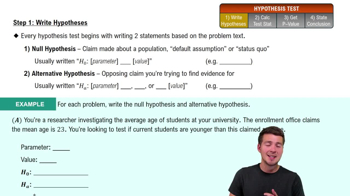
Step 1: Write Hypotheses
Related Practice
Textbook Question

Song Lengths Side-by-side box-and-whisker plots can be used to compare two or more different data sets. Each box-and-whisker plot is drawn on the same number line to compare the data sets more easily. The lengths (in seconds) of songs played at two different concerts are shown.

d. Can you determine which concert lasted longer? Explain.

Textbook Question

Use the frequency histogram

d. describe any patterns with the data..

Textbook Question

Pearson’s Index of Skewness The English statistician Karl Pearson (1857–1936) introduced a formula for the skewness of a distribution.

P = 3 (x̄ - median) / s

Most distributions have an index of skewness between -3 and 3. When P > 0, the data are skewed right. When P < 0, the data are skewed left. When P = 0, the data are symmetric. Calculate the coefficient of skewness for each distribution. Describe the shape of each.


e. x̄ = 155, s = 20.0, median = 175

Textbook Question

Studying Refer to the data set in Exercise 23 and the box-and-whisker plot you drew that represents the data set.


c. You randomly select one student from the sample. What is the likelihood that the student studied less than 2 hours per day? Write your answer as a percent.

1
views
Textbook Question

Pearson’s Index of Skewness The English statistician Karl Pearson (1857–1936) introduced a formula for the skewness of a distribution.

P = 3 (x̄ - median) / s

Most distributions have an index of skewness between -3 and 3. When P > 0, the data are skewed right. When P < 0, the data are skewed left. When P = 0, the data are symmetric. Calculate the coefficient of skewness for each distribution. Describe the shape of each.


c. x̄ = 9.2, s = 1.8, median = 9.2

Textbook Question

Use the frequency histogram

describe any patterns with the data..