Ch. 2 - Descriptive Statistics
Larson - Elementary Statistics: Picturing the World 8th Edition
Larson8th EditionElementary Statistics: Picturing the WorldISBN: 9780137493470Not the one you use?Change textbook
Chapter 2, Problem 2.5.57d

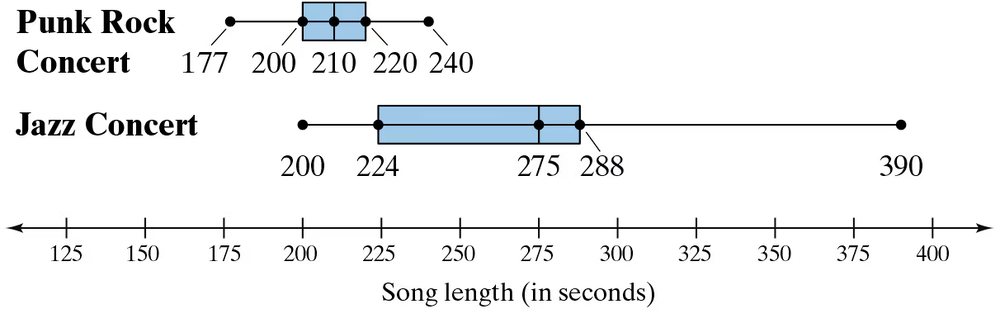
Song Lengths Side-by-side box-and-whisker plots can be used to compare two or more different data sets. Each box-and-whisker plot is drawn on the same number line to compare the data sets more easily. The lengths (in seconds) of songs played at two different concerts are shown.
Side-by-side box-and-whisker plots comparing song lengths from Punk Rock and Jazz concerts, measured in seconds.
d. Can you determine which concert lasted longer? Explain.

Verified step by step guidance
1
Step 1: Observe the box-and-whisker plots for both concerts. The Punk Rock Concert has song lengths ranging from 177 seconds (minimum) to 240 seconds (maximum), while the Jazz Concert has song lengths ranging from 200 seconds (minimum) to 390 seconds (maximum).
Step 2: Compare the interquartile ranges (IQRs) of the two concerts. The Punk Rock Concert has an IQR from 200 seconds (Q1) to 220 seconds (Q3), while the Jazz Concert has an IQR from 224 seconds (Q1) to 288 seconds (Q3). This indicates that Jazz songs tend to be longer on average.
Step 3: Analyze the medians of the two data sets. The median for the Punk Rock Concert is 210 seconds, while the median for the Jazz Concert is 275 seconds. This further supports that Jazz songs are generally longer.
Step 4: Consider the maximum song lengths. The longest song in the Punk Rock Concert is 240 seconds, whereas the longest song in the Jazz Concert is 390 seconds. This suggests that the Jazz Concert likely lasted longer due to longer individual songs.
Step 5: Conclude that the Jazz Concert likely lasted longer because its songs have higher medians, a wider range, and longer maximum song lengths compared to the Punk Rock Concert.

Verified video answer for a similar problem:

This video solution was recommended by our tutors as helpful for the problem above.
Video duration:
2m
Was this helpful?

Key Concepts

Here are the essential concepts you must grasp in order to answer the question correctly.

Box-and-Whisker Plot

A box-and-whisker plot is a graphical representation of a data set that displays its minimum, first quartile, median, third quartile, and maximum. The 'box' shows the interquartile range (IQR), which contains the middle 50% of the data, while the 'whiskers' extend to the smallest and largest values within 1.5 times the IQR from the quartiles. This visualization helps in comparing distributions and identifying outliers.
Recommended video:
Guided course
07:38
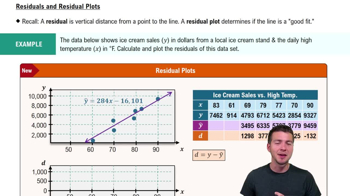
Residuals and Residual Plots

Quartiles

Quartiles are values that divide a data set into four equal parts, each containing 25% of the data. The first quartile (Q1) is the median of the lower half, the second quartile (Q2) is the overall median, and the third quartile (Q3) is the median of the upper half. Understanding quartiles is essential for interpreting box-and-whisker plots, as they provide insights into the spread and central tendency of the data.
Recommended video:
Guided course
04:51
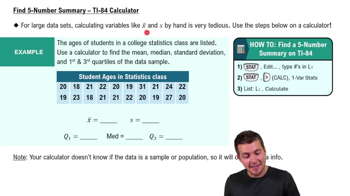
Find 5-Number Summary - TI-84 Calculator

Comparison of Data Sets

Comparing data sets involves analyzing their central tendencies and variability to draw conclusions about their differences. In the context of the box-and-whisker plots for the Punk Rock and Jazz concerts, one can assess which concert had longer song lengths by examining the medians and ranges of the two distributions. This comparison helps in understanding the overall duration and characteristics of the concerts.
Recommended video:
Guided course
04:39
Visualizing Qualitative vs. Quantitative Data