
Ch. 2 - Descriptive Statistics
Larson - Elementary Statistics: Picturing the World 8th Edition
Larson8th EditionElementary Statistics: Picturing the WorldISBN: 9780137493470Not the one you use?Change textbook
Chapter 2, Problem 2.4.55c

Pearson’s Index of Skewness The English statistician Karl Pearson (1857–1936) introduced a formula for the skewness of a distribution.
P = 3 (x̄ - median) / s
Most distributions have an index of skewness between -3 and 3. When P > 0, the data are skewed right. When P < 0, the data are skewed left. When P = 0, the data are symmetric. Calculate the coefficient of skewness for each distribution. Describe the shape of each.


c. x̄ = 9.2, s = 1.8, median = 9.2

Verified step by step guidance
1
Step 1: Recall the formula for Pearson's Index of Skewness: P = 3 * (x̄ - median) / s. Here, x̄ represents the mean, 'median' is the median of the data, and 's' is the standard deviation.
Step 2: Substitute the given values into the formula. From the problem, x̄ = 9.2, median = 9.2, and s = 1.8. The formula becomes P = 3 * (9.2 - 9.2) / 1.8.
Step 3: Simplify the numerator (x̄ - median). Since x̄ and the median are equal (9.2 - 9.2 = 0), the numerator becomes 0.
Step 4: Divide the numerator by the standard deviation. Since the numerator is 0, dividing it by any non-zero value (in this case, 1.8) will result in 0.
Step 5: Interpret the result. When P = 0, the data distribution is symmetric. Therefore, the shape of the distribution is symmetric.

Verified video answer for a similar problem:

This video solution was recommended by our tutors as helpful for the problem above.
Video duration:
1m
Was this helpful?

Key Concepts

Here are the essential concepts you must grasp in order to answer the question correctly.

Skewness

Skewness is a statistical measure that describes the asymmetry of a distribution. A positive skew indicates that the tail on the right side of the distribution is longer or fatter than the left side, while a negative skew indicates the opposite. A skewness of zero suggests a symmetric distribution. Understanding skewness helps in interpreting the shape and behavior of data distributions.
Recommended video:
04:41
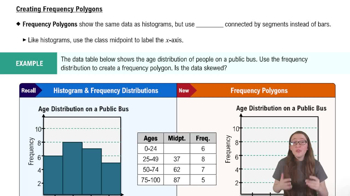
Creating Frequency Polygons

Pearson's Index of Skewness

Pearson's Index of Skewness is a specific formula used to quantify the skewness of a distribution. It is calculated as P = 3(x̄ - median) / s, where x̄ is the mean, median is the median value, and s is the standard deviation. This index provides insight into the direction and degree of skewness, aiding in the analysis of data distributions.
Recommended video:
04:41
Creating Frequency Polygons

Mean, Median, and Standard Deviation

The mean is the average of a data set, the median is the middle value when the data is ordered, and the standard deviation measures the dispersion of data points around the mean. These three statistics are fundamental in understanding the characteristics of a distribution. They are essential for calculating Pearson's Index of Skewness and interpreting the shape of the distribution.
Recommended video:
Guided course
08:45
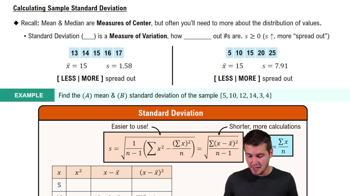
Calculating Standard Deviation
Related Practice
Textbook Question

Extending Concepts


Golf The distances (in yards) for nine holes of a golf course are listed.

336 393 408 522 147 504 177 375 360


d. Use your results from part (c) to explain how to quickly find the mean and the median of the original data set when the distances are converted to inches.

Textbook Question

Using and Interpreting Concepts


Using and Interpreting Concepts Finding Quartiles, Interquartile Range, and Outliers In Exercises 11 and 12,

(c) identify any outliers.


56 63 51 60 57 60 60 54 63 59 80 63 60 62 65

Textbook Question

Use the frequency histogram

d. describe any patterns with the data..

Textbook Question

What Would You Do? You work at a bank and are asked to recommend the amount of cash to put in an ATM each day. You do not want to put in too much (which would cause security concerns) or too little (which may create customer irritation). The daily withdrawals (in hundreds of dollars) for 30 days are listed. 72 84 61 76 104 76 86 92 80 88 98 76 97 82 84 67 70 81 82 89 74 73 86 81 85 78 82 80 91 83

If you are willing to run out of cash on 10% of the days, how much cash should you put in the ATM each day? Explain.

7
views
Textbook Question

Studying Refer to the data set in Exercise 23 and the box-and-whisker plot you drew that represents the data set.


c. You randomly select one student from the sample. What is the likelihood that the student studied less than 2 hours per day? Write your answer as a percent.

1
views
Textbook Question

Use the frequency histogram

describe any patterns with the data..