Skip to main content
Introductory Statistics
My Course
Learn
Exam Prep
AI Tutor
Study Guides
Textbook Solutions
Flashcards
Explore
Try the app
My Course
Learn
Exam Prep
AI Tutor
Study Guides
Textbook Solutions
Flashcards
Explore
Try the app
Back
Two-Way ANOVA - Excel definitions
You can tap to flip the card.
Two-Way ANOVA
You can tap to flip the card.
👆
Two-Way ANOVA
Statistical method for comparing means across two factors, allowing assessment of their individual and combined effects.
Track progress
Control buttons has been changed to "navigation" mode.
1/15
Related flashcards
Related practice
Recommended videos
Two-Way ANOVA - Excel quiz
Two-Way ANOVA - Excel
15 Terms
Two-Way ANOVA
14. ANOVA
5 problems
Topic
Justin
14. ANOVA - Part 1 of 2
4 topics
12 problems
Chapter
Ally
14. ANOVA - Part 2 of 2
1 topic
3 problems
Chapter
Justin
Guided course
08:34
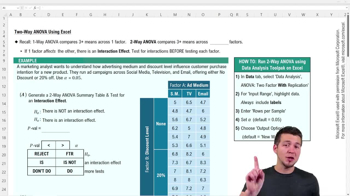
Two-Way ANOVA Using Excel
5
views
Guided course
09:46
Two-Way ANOVA Using Excel Example 1
4
views
Terms in this set (15)
Hide definitions
Two-Way ANOVA
Statistical method for comparing means across two factors, allowing assessment of their individual and combined effects.
Interaction Effect
Phenomenon where the influence of one factor depends on the level of another, complicating interpretation of mean differences.
Factor
Categorical variable whose levels are used to group data for comparison in ANOVA analyses.
Level
Distinct category within a factor, such as types of advertising or discount percentages.
Null Hypothesis
Default assumption stating no interaction or difference in means between groups or factors.
Alternative Hypothesis
Statement suggesting the presence of interaction or differences in means among groups or factors.
P-Value
Probability measure used to determine statistical significance; compared to alpha to guide hypothesis decisions.
Alpha
Threshold for statistical significance, commonly set at 0.05, guiding whether to reject the null hypothesis.
Replication
Design feature in ANOVA where multiple observations are collected for each combination of factor levels.
Source of Variation
Component in ANOVA summary tables identifying where differences in data arise, such as factors or interaction.
F Statistic
Ratio used in ANOVA to compare variance between groups to variance within groups, indicating significance.
Data Analysis Toolpak
Excel add-in providing automated statistical calculations, including ANOVA summary tables.
Summary Table
Output in ANOVA displaying statistics for each factor, interaction, and overall variation.
Advertising Medium
Example factor in business analytics, with levels such as social media, TV, and email.
Discount Level
Example factor representing different price reductions, such as none or 20%.
 BackBack
 08:34
08:34