- Download the worksheet to save time writing
- Start solving the practice problems
- If you're stuck, watch the video solutions
- See your summary to get more insights

The primary purpose of conducting Tukey pairwise comparisons after a significant ANOVA is to:
In a manufacturing study two machine settings yield average defect rates 14 and 11 (units: percent). Each setting used n = 16 samples, and MSE from ANOVA is 4.0. If the q critical value is 4.30, compute q for these two settings and the Tukey decision.
In a pilot study with groups P, Q, R, S each with n = 6, the ANOVA indicates a significant overall F. MSE = 5.0, group means are P = 10, Q = 12, R = 16, S = 23. Degrees of freedom for error is 24, and the studentized range critical value for k = 4 and df = 24 at alpha = 0.05 is qcrit = 4.03. Calculate which pairwise comparisons are significant.
Which statement best describes the difference between a one-way ANOVA and a two-way ANOVA?
Suppose you are conducting a two-way ANOVA on a dataset with three treatments and four blocks. If the last observation in the third treatment and the second block is altered to be an extreme outlier, what is the most likely effect on the results of the two-way ANOVA?
A two-way ANOVA yields p_interaction = 0.012, p_factorA = 0.004, p_factorB = 0.020 at α = 0.05. Which interpretation is the most appropriate?
A researcher collects data on the reaction times (in units of milliseconds) of drivers in response to three different types of traffic signals: red, yellow, and green. The goal is to determine whether the mean reaction time differs among the signal types. Which characteristic of this scenario suggests that a one-way analysis of variance (ANOVA) is appropriate?
For a right-tailed ANOVA test, what is the critical -value when , numerator degrees of freedom , and denominator degrees of freedom ?
A researcher investigates the average number of customer complaints per week received by three different service centers: Center A, Center B, and Center C. A random sample of weekly complaints was recorded over several weeks for each center, as shown below:
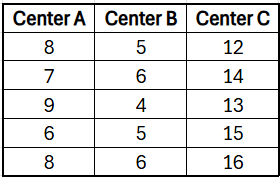
At the significance level, test the claim that the mean number of weekly complaints is the same across the three service centers. If the null hypothesis is rejected, identify which center appears different and describe how.
Why is it important to reject the omnibus ANOVA null hypothesis before performing Tukey-Kramer tests?
Given ANOVA output: Sum of squares (Error) = 134.4, df(Error) = 28, MS(Error) = 4.8. There are 4 groups with sizes 8, 9, 7, and 7 (N = 31). For the Tukey-Kramer procedure which MSE and error degrees of freedom will you use, and why?
A study with three groups obtained the following Tukey HSD q-values: q12 = 1.95, q13 = 4.50, q23 = 2.55, and q_critical = 3.05. For each pairwise comparison, state the null hypotheses, determine which group means differ significantly, and explain what these results imply for follow-up interpretation.