Ch. 9 - Correlation and Regression
Larson - Elementary Statistics: Picturing the World 8th Edition
Larson8th EditionElementary Statistics: Picturing the WorldISBN: 9780137493470Not the one you use?Change textbook
Chapter 9, Problem 9.3.4

The coefficient of determination r^2 is the ratio of which two types of variations? What does r^2 measure? What does 1 - r^2 measure?

Verified step by step guidance
1
Understand that the coefficient of determination, denoted as r2, is defined as the ratio of the explained variation to the total variation in the data. Specifically, it is the ratio of the regression sum of squares (explained variation) to the total sum of squares (total variation).
Express this relationship mathematically as r2 = \(\frac{\text{Explained Variation}\)}{\(\text{Total Variation}\)} = \(\frac{SS_{reg}\)}{SS_{tot}}, where SS_{reg} is the sum of squares due to regression and SS_{tot} is the total sum of squares.
Interpret what r2 measures: it quantifies the proportion of the variance in the dependent variable that is predictable from the independent variable(s). In other words, it tells us how well the regression model explains the observed data.
Understand that 1 - r2 represents the proportion of the total variation that is not explained by the regression model. This is also known as the unexplained variation or the residual variation.
Summarize that r2 measures the strength of the relationship between variables in terms of explained variance, while 1 - r2 measures the amount of variation left unexplained by the model.

Verified video answer for a similar problem:

This video solution was recommended by our tutors as helpful for the problem above.
Video duration:
4m
Was this helpful?

Key Concepts

Here are the essential concepts you must grasp in order to answer the question correctly.

Coefficient of Determination (r²)

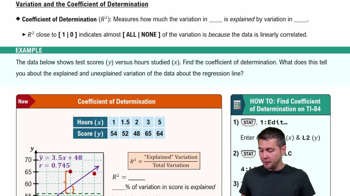
The coefficient of determination, denoted as r², measures the proportion of the total variation in the dependent variable that is explained by the independent variable(s) in a regression model. It quantifies how well the regression line fits the data.
Recommended video:
Guided course
06:14
Coefficient of Determination

Types of Variation: Explained vs. Total Variation

Total variation refers to the overall variability in the observed data, while explained variation is the portion of this variability accounted for by the regression model. The ratio of explained variation to total variation gives r².
Recommended video:
Guided course
06:14
Coefficient of Determination

Unexplained Variation and 1 - r²

The term 1 - r² represents the proportion of total variation that the regression model fails to explain, also known as unexplained or residual variation. It indicates the amount of variability due to factors outside the model.
Recommended video:
Guided course
06:14
Coefficient of Determination