Ch. 6 - Confidence Intervals
Larson - Elementary Statistics: Picturing the World 8th Edition
Larson8th EditionElementary Statistics: Picturing the WorldISBN: 9780137493470Not the one you use?Change textbook
Chapter 6, Problem 6.1d

In a survey of 2096 U.S. adults, 1740 think football teams of all levels should require players who suffer a head injury to take a set amount of time off from playing to recover. (Adapted from The Harris Poll)
d. Find the minimum sample size needed to estimate the population proportion at the 99% confidence level to ensure that the estimate is accurate within 3% of the population proportion.

Verified step by step guidance
1
Step 1: Identify the key components of the problem. The confidence level is 99%, the margin of error (E) is 3% or 0.03, and the sample proportion (p̂) is calculated as the number of favorable responses divided by the total sample size: p̂ = 1740 / 2096.
Step 2: Recall the formula for the minimum sample size needed to estimate a population proportion: n = (Z² * p̂ * (1 - p̂)) / E². Here, Z is the critical value corresponding to the 99% confidence level.
Step 3: Determine the critical value (Z) for a 99% confidence level. Using a Z-table or standard normal distribution, the Z-value for 99% confidence is approximately 2.576.
Step 4: Substitute the values into the formula. Use p̂ from Step 1, Z = 2.576, and E = 0.03. The formula becomes: n = (2.576² * p̂ * (1 - p̂)) / 0.03².
Step 5: Simplify the expression to calculate the minimum sample size. Ensure that the result is rounded up to the nearest whole number, as sample size must be an integer.

Verified video answer for a similar problem:

This video solution was recommended by our tutors as helpful for the problem above.
Video duration:
2m
Was this helpful?

Key Concepts

Here are the essential concepts you must grasp in order to answer the question correctly.

Population Proportion

The population proportion refers to the fraction of a population that exhibits a certain characteristic. In this context, it represents the percentage of U.S. adults who believe that football players should take time off after a head injury. Understanding this concept is crucial for estimating how representative a sample is of the larger population.
Recommended video:
02:35
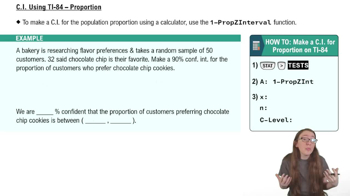
Finding a Confidence Interval for a Population Proportion Using a TI84

Sample Size Calculation

Sample size calculation is a statistical method used to determine the number of observations or replicates needed to ensure that the results of a survey or experiment are reliable. It takes into account the desired confidence level, margin of error, and the estimated population proportion. In this case, it helps to find the minimum number of respondents needed to accurately estimate the population proportion within a specified margin of error.
Recommended video:
05:11
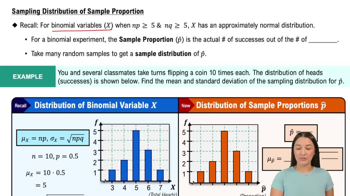
Sampling Distribution of Sample Proportion

Confidence Level

The confidence level indicates the degree of certainty that the population parameter lies within the confidence interval calculated from the sample data. A 99% confidence level means that if the same survey were conducted multiple times, 99% of the calculated intervals would contain the true population proportion. This high level of confidence is important for making informed decisions based on survey results.
Recommended video:
06:33
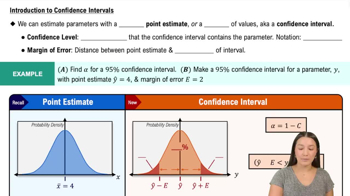
Introduction to Confidence Intervals