Describe how the t-distribution curve changes as the sample size increases.

Ch. 6 - Confidence Intervals
Larson8th EditionElementary Statistics: Picturing the WorldISBN: 9780137493470Not the one you use?Change textbook
Chapter 6, Problem 6.3.21
In Exercise 11, would it be unusual for the population proportion to be 72.5%? Explain.
Verified step by step guidance1
Step 1: Identify the context of the problem. The question is asking whether a population proportion of 72.5% is unusual. To determine this, we need to assess the concept of 'unusual' in statistics, which typically refers to values that are far from the mean (e.g., more than 2 standard deviations away).
Step 2: Recall the formula for the standard error of the proportion (SE). The formula is: , where is the population proportion and is the sample size.
Step 3: Determine the z-score for the given proportion. The z-score formula is: , where is the hypothesized population proportion, is the observed proportion, and is the standard error.
Step 4: Compare the z-score to the critical values for a standard normal distribution. Typically, a z-score beyond ±2 is considered unusual because it corresponds to the tails of the distribution (less than 5% of the data).
Step 5: Conclude whether the population proportion of 72.5% is unusual based on the z-score and the critical values. If the z-score is within ±2, it is not unusual; otherwise, it is unusual.

Verified video answer for a similar problem:
This video solution was recommended by our tutors as helpful for the problem above.
Video duration:
2mWas this helpful?
Key Concepts
Here are the essential concepts you must grasp in order to answer the question correctly.
Population Proportion
Population proportion refers to the fraction of a population that possesses a certain characteristic. It is a key parameter in statistics, often denoted as 'p', and is used to summarize categorical data. Understanding the population proportion helps in making inferences about the entire population based on sample data.
Recommended video:
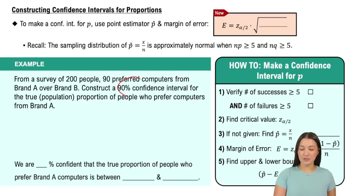
Constructing Confidence Intervals for Proportions
Statistical Significance
Statistical significance assesses whether the observed data deviates from what would be expected under a null hypothesis. A population proportion of 72.5% may be considered unusual if it falls outside the range of expected values based on sample data and confidence intervals. This concept is crucial for determining if a result is likely due to chance or represents a true effect.
Recommended video:
Guided course
Parameters vs. Statistics
Confidence Intervals
A confidence interval provides a range of values within which the true population parameter is expected to lie, with a certain level of confidence (e.g., 95%). If 72.5% falls outside this interval, it may indicate that this proportion is unusual or not representative of the population. Confidence intervals are essential for understanding the precision of estimates and making informed decisions based on sample data.
Recommended video:
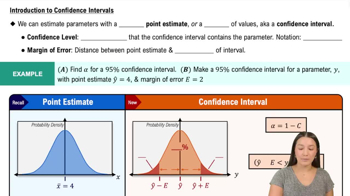
Introduction to Confidence Intervals
Related Practice
Textbook Question
Textbook Question
Constructing Confidence Intervals In Exercises 13 and 14, construct a 99% confidence interval for the population proportion. Interpret the results.
New Year’s Resolutions In a survey of 1790 U.S. adults in a recent year, 816 have a New Year’s resolution related to their health. (Adapted from Finder)
Textbook Question
Constructing Confidence Intervals In Exercises 27 and 28, use the figure, which shows the results of a survey in which 1021 U.S. adults were asked whether they see each of the possible threats to the vital interests of the United States as a critical threat in the next 10 years. (Source: Gallup)
Critical Threats Construct a 95% confidence interval for the population proportion of U.S. adults who gave each response.