
Ch. 6 - Confidence Intervals
Larson - Elementary Statistics: Picturing the World 8th Edition
Larson8th EditionElementary Statistics: Picturing the WorldISBN: 9780137493470Not the one you use?Change textbook
Chapter 6, Problem 6.1.58c

Finite Population Correction Factor In Exercises 57 and 58, use the information below.
In this section, you studied the construction of a confidence interval to estimate a population mean. In each case, the underlying assumption was that the sample size n was small in comparison to the population size N. When n ≥ 0.05N however, the formula that determines the standard error of the mean needs to be adjusted, as shown below.
[IMAGE]
Recall from the Section 5.4 exercises that the expression sqrt[(N-n)/(n-1)] is called a finite population correction factor. The margin of error is
[IMAGE]
Use the finite population correction factor to construct each confidence interval for the population mean.
c. c = 0.95, xbar = 40.3, σ = 0.5, N = 300, n = 68.

Verified step by step guidance
1
Identify the given values: confidence level (c = 0.95), sample mean (x̄ = 40.3), population standard deviation (σ = 0.5), population size (N = 300), and sample size (n = 68).
Check if the finite population correction factor is needed by verifying if n ≥ 0.05N. Calculate 0.05N = 0.05 × 300 = 15. Since n = 68 is greater than 15, the finite population correction factor is required.
Calculate the finite population correction factor using the formula: sqrt((N - n) / (N - 1)). Substitute the values: sqrt((300 - 68) / (300 - 1)).
Adjust the standard error of the mean using the formula: SE = (σ / sqrt(n)) × sqrt((N - n) / (N - 1)). Substitute the values: SE = (0.5 / sqrt(68)) × sqrt((300 - 68) / (300 - 1)).
Construct the confidence interval using the formula: x̄ ± z* × SE, where z* is the critical value for the confidence level (c = 0.95). Look up the z* value for a 95% confidence level (z* ≈ 1.96) and substitute the values into the formula: 40.3 ± 1.96 × SE.

Verified video answer for a similar problem:

This video solution was recommended by our tutors as helpful for the problem above.
Video duration:
4m
Was this helpful?

Key Concepts

Here are the essential concepts you must grasp in order to answer the question correctly.

Finite Population Correction Factor

The Finite Population Correction Factor (FPC) is used when sampling from a finite population, particularly when the sample size is a significant fraction of the total population. It adjusts the standard error of the mean to account for the reduced variability in the sample due to the limited population size. The formula is sqrt[(N-n)/(N-1)], where N is the population size and n is the sample size, ensuring more accurate confidence intervals.
Recommended video:
04:48
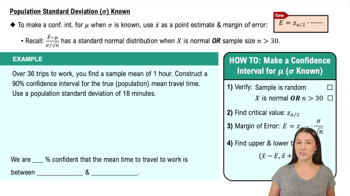
Population Standard Deviation Known

Confidence Interval

A confidence interval is a range of values, derived from sample statistics, that is likely to contain the true population parameter with a specified level of confidence, typically expressed as a percentage (e.g., 95%). It is calculated using the sample mean, the standard error, and a critical value from the normal distribution. The width of the interval reflects the uncertainty associated with the sample estimate.
Recommended video:
06:33
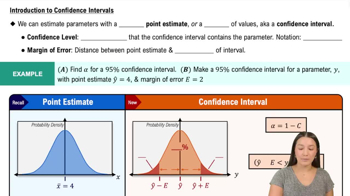
Introduction to Confidence Intervals

Standard Error of the Mean

The Standard Error of the Mean (SEM) quantifies the amount of variability in sample means that you would expect if you took multiple samples from the same population. It is calculated as the population standard deviation divided by the square root of the sample size (σ/√n). When the sample size is large or when using the FPC, the SEM is adjusted to provide a more accurate estimate of the population mean's variability.
Recommended video:
Guided course
04:52
Calculating the Mean
Related Practice
Textbook Question

In a survey of 2096 U.S. adults, 1740 think football teams of all levels should require players who suffer a head injury to take a set amount of time off from playing to recover. (Adapted from The Harris Poll)

d. Find the minimum sample size needed to estimate the population proportion at the 99% confidence level to ensure that the estimate is accurate within 3% of the population proportion.

Textbook Question

Constructing a Confidence Interval In Exercises 25–28, use the data set to (c) construct a 99% confidence interval for the population mean. Assume the population is normally distributed.

SAT Scores The SAT scores of 12 randomly selected high school seniors

Textbook Question

Senate Filibuster You wish to estimate, with 99% confidence, the population proportion of U.S. adults who disapprove of the U.S Senate’s use of the filibuster. Your estimate must be accurate within 2% of the population proportion.

b. Find the minimum sample size needed, using a prior survey that found that 34% of U.S. adults disapprove of the U.S Senate’s use of the filibuster. (Source: Monmouth University)

Textbook Question

When all other quantities remain the same, how does the indicated change affect the width of a confidence interval? Explain.

c. Increase in the population standard deviation

Textbook Question

Constructing a Confidence Interval In Exercises 25–28, use the data set to (c) construct a 99% confidence interval for the population mean. Assume the population is normally distributed.

Homework The weekly time spent (in hours) on homework for 18 randomly selected high school students