
Ch. 6 - Confidence Intervals
Larson - Elementary Statistics: Picturing the World 8th Edition
Larson8th EditionElementary Statistics: Picturing the WorldISBN: 9780137493470Not the one you use?Change textbook
Chapter 6, Problem 6.3.18b

Senate Filibuster You wish to estimate, with 99% confidence, the population proportion of U.S. adults who disapprove of the U.S Senate’s use of the filibuster. Your estimate must be accurate within 2% of the population proportion.
b. Find the minimum sample size needed, using a prior survey that found that 34% of U.S. adults disapprove of the U.S Senate’s use of the filibuster. (Source: Monmouth University)

Verified step by step guidance
1
Identify the formula for determining the minimum sample size for estimating a population proportion with a given confidence level and margin of error. The formula is: n >= z2p(1-p)E2, where z is the z-score corresponding to the confidence level, p is the estimated population proportion, and E is the margin of error.
Determine the values for the variables in the formula. The confidence level is 99%, so the z-score corresponding to this level is approximately 2.576. The estimated population proportion p is 0.34 (from the prior survey), and the margin of error E is 0.02 (2%).
Substitute the values into the formula: n >= 2.5762(0.34)(1-0.34)0.022.
Simplify the numerator by calculating 2.5762 and (0.34)(1-0.34). Then simplify the denominator by squaring 0.02.
Divide the simplified numerator by the simplified denominator to find the minimum sample size n. If the result is not a whole number, always round up to the nearest whole number, as sample size must be an integer.

Verified video answer for a similar problem:

This video solution was recommended by our tutors as helpful for the problem above.
Video duration:
2m
Was this helpful?

Key Concepts

Here are the essential concepts you must grasp in order to answer the question correctly.

Population Proportion

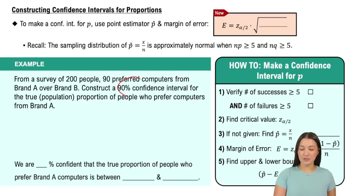
The population proportion refers to the fraction of a population that exhibits a certain characteristic, in this case, U.S. adults who disapprove of the Senate's use of the filibuster. It is denoted as 'p' and is crucial for estimating how representative a sample will be of the entire population. Understanding this concept helps in determining the accuracy and reliability of survey results.
Recommended video:
05:45
Constructing Confidence Intervals for Proportions

Sample Size Calculation

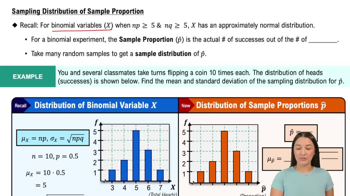
Sample size calculation is the process of determining the number of observations or replicates needed to ensure that a statistical estimate is reliable and meets specified criteria, such as confidence level and margin of error. In this scenario, the formula incorporates the desired confidence level (99%) and the margin of error (2%) to find the minimum sample size required to estimate the population proportion accurately.
Recommended video:
05:11
Sampling Distribution of Sample Proportion

Confidence Level

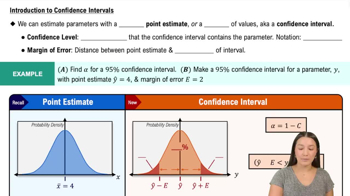
The confidence level indicates the degree of certainty that the population parameter lies within a specified interval around the sample estimate. A 99% confidence level means that if the same sampling method were repeated multiple times, 99% of the calculated intervals would contain the true population proportion. This concept is essential for understanding the reliability of the estimate derived from the sample.
Recommended video:
06:33
Introduction to Confidence Intervals
Related Practice
Textbook Question

Constructing Confidence Intervals In Exercises 13–24, assume the sample is from a normally distributed population and construct the indicated confidence intervals for (b) the population standard deviation σ. Interpret the results.

[APPLET] Earnings The annual earnings (in thousands of dollars) of 21 randomly selected level 1 computer hardware engineers are listed. Use a 99% level of confidence. (Adapted from Salary.com)

Textbook Question

Constructing a Confidence Interval In Exercises 25–28, use the data set to (c) construct a 99% confidence interval for the population mean. Assume the population is normally distributed.

SAT Scores The SAT scores of 12 randomly selected high school seniors

Textbook Question

Constructing Confidence Intervals In Exercises 13–24, assume the sample is from a normally distributed population and construct the indicated confidence intervals for (b) the population standard deviation σ. Interpret the results.

Drive-Thru Times The times (in seconds) spent by a random sample of 28 customers in the drive-thru of a fast-food restaurant have a sample standard deviation of 56.1. Use a 98% level of confidence.

Textbook Question

Constructing a Confidence Interval In Exercises 25–28, use the data set to (b) find the sample standard deviation. Assume the population is normally distributed.

SAT Scores The SAT scores of 12 randomly selected high school seniors

Textbook Question

Finite Population Correction Factor In Exercises 57 and 58, use the information below.

In this section, you studied the construction of a confidence interval to estimate a population mean. In each case, the underlying assumption was that the sample size n was small in comparison to the population size N. When n ≥ 0.05N however, the formula that determines the standard error of the mean needs to be adjusted, as shown below.

[IMAGE]

Recall from the Section 5.4 exercises that the expression sqrt[(N-n)/(n-1)] is called a finite population correction factor. The margin of error is

[IMAGE]

Use the finite population correction factor to construct each confidence interval for the population mean.

c. c = 0.95, xbar = 40.3, σ = 0.5, N = 300, n = 68.

Textbook Question

Constructing a Confidence Interval In Exercises 25–28, use the data set to (c) construct a 99% confidence interval for the population mean. Assume the population is normally distributed.

Homework The weekly time spent (in hours) on homework for 18 randomly selected high school students