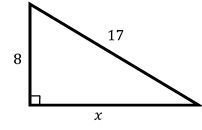
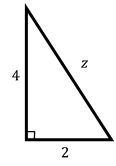
In the study of right triangles, a fundamental concept is the Pythagorean theorem, which is essential for solving problems involving the lengths of the sides. This theorem states that in a right triangle, the sum of the squares of the lengths of the two shorter sides (often referred to as legs) is equal to the square of the length of the longest side, known as the hypotenuse. The equation can be expressed as:
\[a^2 + b^2 = c^2\]
Here, \(a\) and \(b\) represent the lengths of the legs, while \(c\) represents the length of the hypotenuse. It is crucial to remember that this theorem applies only to right triangles, where one angle measures 90 degrees.
To illustrate the application of the Pythagorean theorem, consider a right triangle where one leg measures 4 units and the other leg measures 3 units. To find the hypotenuse \(c\), we can substitute the values into the equation:
\[4^2 + 3^2 = c^2\]
Calculating this gives:
\[16 + 9 = c^2\]
Thus, we have:
\[25 = c^2\]
To find \(c\), we take the square root of both sides:
\[c = \sqrt{25} = 5\]
This indicates that the hypotenuse of the triangle is 5 units long, which is consistent with the property that the hypotenuse is the longest side.
In another scenario, if we know the hypotenuse and one leg, we can still use the Pythagorean theorem to find the unknown leg. For example, if the hypotenuse \(c\) is 10 units and one leg \(b\) is 6 units, we can set up the equation as follows:
\[a^2 + 6^2 = 10^2\]
Substituting the known values gives:
\[a^2 + 36 = 100\]
To isolate \(a^2\), we subtract 36 from both sides:
\[a^2 = 100 - 36\]
Thus, we find:
\[a^2 = 64\]
Taking the square root of both sides yields:
\[a = \sqrt{64} = 8\]
In this case, the length of the unknown leg is 8 units, which again confirms that the hypotenuse (10 units) is longer than both legs.
Understanding and applying the Pythagorean theorem is crucial for solving various geometric problems involving right triangles, making it a key concept in mathematics.