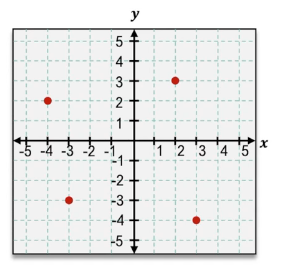
Understanding the domain and range is essential when working with relations and functions. The domain refers to the set of all possible input values, typically represented as the x-values, while the range consists of all possible output values, or the y-values. These concepts help describe the behavior and limitations of functions and relations.
When given a relation as a set of ordered pairs or a table, finding the domain and range involves listing all the unique x-values for the domain and all the unique y-values for the range. For example, if a relation includes the ordered pairs (-2, 2), (1, 1), (3, -2), and (4, 4), the domain is the set {-2, 1, 3, 4} and the range is {2, 1, -2, 4}. This straightforward approach works well for discrete data points.
However, when dealing with continuous functions represented by graphs, the domain and range often include infinitely many values. In such cases, interval notation is used to express the domain and range efficiently. Interval notation uses brackets [ ] to indicate inclusion of endpoints and parentheses ( ) to indicate exclusion. For example, if a graph starts at x = -4 (included) and extends indefinitely to the right, the domain is written as \([-4, \infty)\). Similarly, if the range starts at y = -2 (included) and extends upward indefinitely, the range is \([-2, \infty)\).
Recognizing whether to list values explicitly or use interval notation depends on the nature of the relation or function. Discrete sets of points call for listing individual values, while continuous graphs require intervals to capture all possible inputs and outputs. Mastering domain and range allows for better analysis and understanding of functions, enabling you to predict their behavior and solve related problems effectively.