Ch 25: Current, Resistance, and EMF
Young & Freedman Calc - University Physics 15th Edition
Young & Freedman Calc15th EditionUniversity PhysicsISBN: 9780135159552Not the one you use?Change textbook
Chapter 25, Problem 19

In household wiring, copper wire 2.052.05 mm in diameter is often used. Find the resistance of a 24.0 24.0-m length of this wire.

Verified step by step guidance
1
First, identify the formula for resistance in a wire, which is given by \( R = \frac{\rho L}{A} \), where \( R \) is the resistance, \( \rho \) is the resistivity of the material, \( L \) is the length of the wire, and \( A \) is the cross-sectional area of the wire.
Determine the resistivity \( \rho \) of copper. This is a known value and can be found in tables of material properties. For copper, \( \rho \approx 1.68 \times 10^{-8} \text{ ohm meters} \).
Calculate the cross-sectional area \( A \) of the wire. Since the wire is cylindrical, use the formula for the area of a circle: \( A = \pi r^2 \), where \( r \) is the radius of the wire. Convert the diameter to radius by dividing by 2: \( r = \frac{2.05 \text{ mm}}{2} = 1.025 \text{ mm} \). Convert this to meters: \( r = 1.025 \times 10^{-3} \text{ m} \).
Substitute the radius into the area formula: \( A = \pi (1.025 \times 10^{-3})^2 \text{ m}^2 \). Calculate this value to find the cross-sectional area.
Finally, substitute the values for \( \rho \), \( L \), and \( A \) into the resistance formula: \( R = \frac{1.68 \times 10^{-8} \times 24.0}{A} \). Calculate \( R \) using the computed area from the previous step.

Verified video answer for a similar problem:

This video solution was recommended by our tutors as helpful for the problem above.
Video duration:
5m
Was this helpful?

Key Concepts

Here are the essential concepts you must grasp in order to answer the question correctly.

Resistance

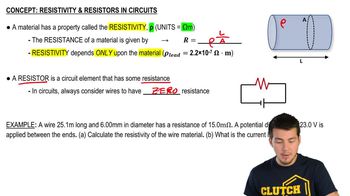
Resistance is a measure of the opposition to the flow of electric current through a conductor. It is determined by the material's properties, length, and cross-sectional area. The formula for resistance is R = ρL/A, where ρ is the resistivity, L is the length, and A is the cross-sectional area.
Recommended video:
Guided course
05:25
Resistivity & Resistors in Circuits

Resistivity

Resistivity is a fundamental property of materials that quantifies how strongly a material opposes the flow of electric current. It is denoted by ρ and is measured in ohm-meters (Ω·m). Copper has a low resistivity, making it an excellent conductor for household wiring.
Recommended video:
Guided course
05:25
Resistivity & Resistors in Circuits

Cross-sectional Area

The cross-sectional area of a wire affects its resistance. For a cylindrical wire, the area A can be calculated using the formula A = π(d/2)^2, where d is the diameter. A larger cross-sectional area results in lower resistance, allowing more current to flow through the wire.
Recommended video:
Guided course
08:10
Calculating the Vector (Cross) Product Using Components